


[DIGITAL Business Africa] – Robotics, powered by the rapid advances of artificial intelligence, is moving to a whole new scale. Beyond factories, humanoid robots are now entering public debate as a technology set to profoundly transform economies and societies. On January 22, 2026, in Davos, Tesla and SpaceX CEO Elon Musk delivered a resolutely optimistic vision of this automated future, echoing hard data that confirms the scale of the ongoing revolution.
According to the International Federation of Robotics (IFR), the global stock of industrial robots in operation exceeded 4.6 million units at the end of 2024, with double-digit annual growth. At this pace, analysts expect more than 10 million industrial robots to be in operation worldwide by 2030, while the global robotics market—estimated at nearly $50 billion in 2024—could exceed $200 billion by 2034. These figures reflect a structural shift: robotics is no longer merely a tool for industrial optimization, but is becoming a core infrastructure of the digital economy.
This quantitative trajectory aligns with Elon Musk’s vision of the massive diffusion of humanoid robots throughout society. In Davos, he stated: “There will be billions of humanoid robots, and I think everyone on Earth will have one and want one.” For the American tech leader, these machines will not be confined to factories or warehouses, but will enter domestic and social life. “Who wouldn’t want a robot to watch over their children, take care of their pets, or look after their elderly parents?” he said, sketching the profile of a universal everyday assistant.
Projections of the economic impact of this robotic wave are commensurate with these ambitions. According to several research firms, the integration of robotics and AI could generate trillions of dollars in productivity gains globally over the next decade, particularly in manufacturing, logistics, healthcare, and services. The humanoid robotics segment, still emerging, is itself valued by some investment banks at between $40 billion and $200 billion by 2035, driven by the convergence of advanced sensors, generative AI, and mechatronics.
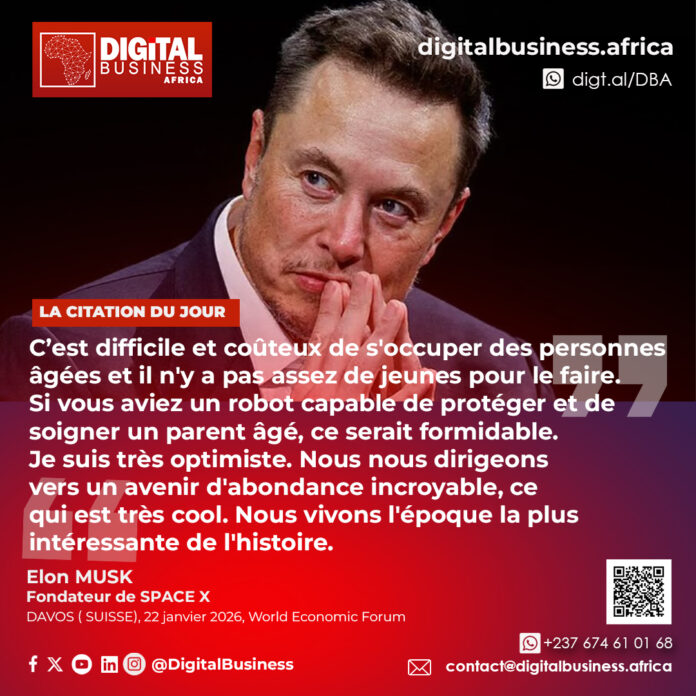
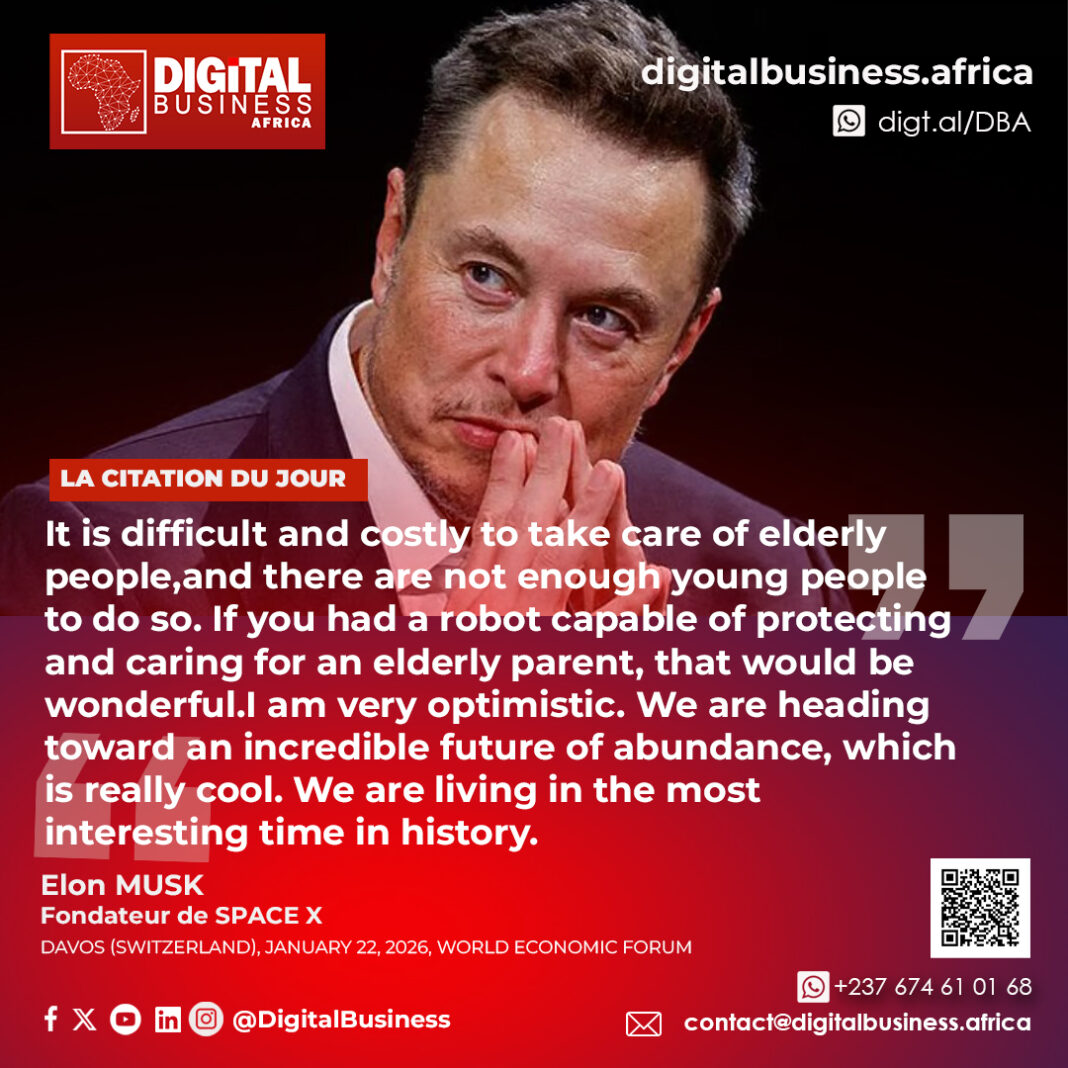
For Musk, one of the most critical use cases relates to addressing population aging. “It is difficult and costly to take care of elderly people, and there are not enough young people to do so,” he recalled, highlighting a structural challenge shared by many economies. In this perspective, humanoid robots could become care assistants, capable of monitoring, assisting, and protecting dependent people. “If you had a robot capable of protecting and caring for an elderly parent, that would be wonderful,” he added, positioning robotics as a technological response to an emerging social crisis.
This vision is part of a broader philosophy of the Tesla founder, who sees robotics and AI as the foundation of a new model of prosperity. “We are heading toward an incredible future of abundance,” he said in Davos, arguing that intelligent automation is the only credible path to sustainably raising living standards worldwide. He concluded on a near-historical note: “We are living in the most interesting time in history.”
Yet this horizon of “abundance” raises major governance challenges. Massive automation is already reshaping labor markets, with risks of job displacement in low-skilled roles, alongside the creation of new professions in the design, maintenance, and supervision of robotic systems. For Africa, the rise of humanoid robots and AI represents both an opportunity for productive catch-up in industry, logistics, and healthcare, and a risk of widening digital divides if public policies fail to anticipate skills development, regulatory frameworks, and equitable access to these technologies.
Between hard projections and visions promoted by tech giants, humanoid robotics is now emerging as one of the defining markers of the next digital decade. The question is no longer whether robots will transform our economies, but how fast—and under what collective rules.
By Beaugas-Orain DJOYUM