

[Digital Business Africa] – Le Next Einstein Forum (NEF) a publié ce 05 août 2019 à Kigali au Rwanda les lauréats de sa troisième promotion des 25 scientifiques africains d’envergure. Tous sont âgés de moins de 42 ans. Leurs recherches et innovations contribuent à relever les défis les plus urgents pour l’Afrique et le monde.
« Je suis ravi de présenter la 3ième promotion des lauréats NEF pour deux raisons : la première est le fait que nous avons presque atteint la parité, avec 11 femmes au sein de la promotion. La seconde raison est la variété des domaines et des pays d’où sont issus les lauréats. Les lauréats sélectionnés font de la recherche de pointe dans le secteur de l’énergie renouvelable, de la nanomatériau et de la nanotechnologie, de la sécurité alimentaire, de la médecine de précision, des systèmes de santé, de la science du climat et de l’urbanisme. Le fait que deux scientifiques sociaux aient été sélectionnés pour cette promotion constitue également une première pour le groupe des lauréats. Nous sommes convaincus que leurs découvertes actuelles et futures résoudront les enjeux mondiaux et nous sommes ravis de vous les présenter », a déclaré Thierry Zomahoun, fondateur , président du Next Einstein Forum et président-directeur général de l’Institut panafricain des sciences mathématiques (AIMS).
Initiative de l’Institut panafricain des sciences mathématiques (AIMS), le NEF récompensera les lauréats lors de sa rencontre Internationale 2020 à Nairobi, au Kenya, le 10 mars 2020, sous le patronage du président Uhuru Kenyatta. Les lauréats NEF perpétueront la tradition qui consiste à présenter leurs recherches innovantes lors de cette rencontre.
NEF Fellows are selected by an International Scientific Program Committee, using a rigorous process that comprises academic and scientific merit, a strong publication record, patents, awards and a track record of funds independently raised for research. Fellows are also required to demonstrate the relevance of their research or innovations to humanity’s grand challenges, as well as a passion for raising Africa’s scientific profile and inspiring the next generation of scientific leaders.
“We are tremendously pleased to welcome the new class to the growing NEF Community of Scientists, and the thirty-five Fellows that preceded this cohort. This Class was selected in record timing because of the quality of their profiles and we look forward to their contributions to our foresight work and public engagement programs like Africa Science Week,” said Dr. Youssef Travaly, Vice President of Science, Innovation and Partnerships.
Entre autre innovations, la seconde promotion a été à l’avant-garde des recherches innovantes en matière de blockchain pour les microcrédits, de bioinformatique pour l’amélioration de la production agricole et de détection non-invasive de la malaria. Plusieurs lauréats ont été récompensés par un million de dollars pour leurs recherches. Les lauréats du NEF ont dirigé la publication du journal scientifique africain du NEF qui en est à son quatrième numéro depuis mars 2018. En reconnaissance de leurs travaux et de leur excellence scientifique, trois lauréats ont rejoint le comité de programme scientifique international du NEF.
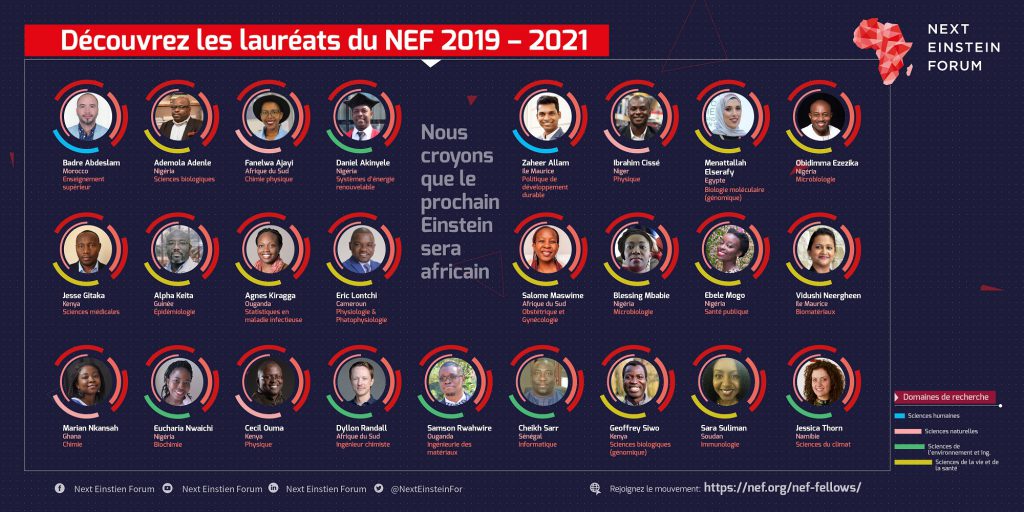
Meet the 2019-2021 NEF Fellows
Dr. Badre Abdselam (Morocco) seeks to contribute in the design and implementation of regional policies on young scientists’ intentional mobility within Africa to optimize brain circulation.
Dr. Ademola Adenle (Nigeria) is leading research in science and technology policy in addressing sustainable development challenges such as climate change, food insecurity, energy and health innovation in Africa.
Dr. Fanelwa Ajayi (South Africa) seeks to develop various nanoparticles particularly with the use of edible substances, such as fruits and vegetables, and finding additional applications for them.
Dr. Daniel Akinyele (Nigeria) is immersed in unveiling deeper insights into planning, developing and managing new electrification systems for energy-poor communities using the social-technical-economic-environmental-policy, or STEEP.
Dr. Zaheer Allam (Mauritius) investigates the dynamics shaping urban life in the Anthropocene to better build policies enhancing both livability and economic levels in future cities, set to host the majority of humans on earth.
Dr. Ibrahim Cissé (Niger) is interested in developing high resolution methods of microscopy that go directly inside living cells, and single bio-molecules which could decode human genome from DNA into RNA.
Dr. Menattallah Elserafy (Egypt) studies DNA repair mechanisms, working to understand cellular processes which deciphered will change diagnostics and pave roads for personalized therapies.
Dr. Obidimma Ezezika (Nigeria) is studying processes that help contribute to developing new industrial models for effectively taking health interventions to scale in sub-Saharan Africa.
Dr. Jesse Gitaka (Kenya) works on malaria elimination, prompt diagnosis and management of sub-clinical maternal bacterial infections that eliminate still births, prematurity, maternal and newborn sepsis and mortality.
Dr. Alpha Keita (Guinea) hopes to develop, together with his team in the Guinea and France, the reservoirs of viruses to better understand the natural history of Ebola virus spread.
Dr. Agnes Kiragga (Uganda) hopes to merge data science and machine learning methods to available “large data” and existing health records to predict and prevent HIV among high-risk groups in Africa.
Dr. Eric Lontchi (Cameroon) investigates ways of combating the burgeoning epidemic of obesity and diabetes, hoping to uncover new insights into the pathogenesis of, and potential treatments for diabetes.
Dr. Salome Maswime (South Africa) leads a research initiative to scale up the implementation of the perinatal problem identification program model to four other healthcare systems in Africa.
Dr. Blesssing Mbabie (Nigeria) seeks to cover the real-time status of antimicrobial resistance and social factors that drive it, discovering natural drugs with high potential inhibitors of antimicrobial resistance mechanism.
Dr. Ebele Mogo (Nigeria) is involved in research that aims to transform societal systems that recognizes African contextual realities when designing healthy communities and preventing non-communicable diseases.
Dr. Vidushi Neergheen-Bhujun (Mauritius) is determined to connect the dots between the role of functional food and cancer prevention.
Dr. Marian Nkansah (Ghana) focuses on developing public knowledge on toxic chemicals from unusual places, and the associated risk on local communities, strengthening the intersection of scientific evidence and policy.
Dr. Eucharia Nwaichi (Nigeria) leads research projects that aim to find sustainable and safe sanitation strategies for the remediation of petroleum-impacted environments in the Niger Delta.
Dr. Cecil Ouma (Kenya) leverages current research on energy materials and associated technologies, with hope to innovate cheap and small-scale off-grid technologies for rural and peri-urban settlements in Africa.
Dr. Dyllon Randall (South Africa) hopes to change our modern sanitation systems to focus on resource recovery rather than mere treatment, moving communities to rethink “waste” as valuable resources.
Dr. Samson Rwahwire (Uganda) is using his knowledge of material science and nanotechnology to modify bitumen for road construction utilizing green nanoscience as a crosslinker for plastic waste.
Dr. Cheikh Sarr (Senegal) is interested in developing a prototype of a self-driven vehicle, equipped by a lot of sensors networks in order to facilitate the mobility of people with disabilities.
Dr. Geoffrey Siwo (Kenya) hopes to combine artificial intelligence with genetic data and scientific knowledge as a means of accelerating the discovery of fundamental principles that could enable equitable development of precision medicine.
Dr. Sara Suliman (Sudan), co-inventor of a four-gene biomarker, investigates why genes involved in electrolyte regulation across mammalian cell membranes might confer susceptibility to the world’s deadliest pathogen: Mycobacterium tuberculosis.
Dr. Jessica Thorn (Namibia) uses social-ecological system modelling and participatory scenario planning to investigate and measure the impact of development corridors in land use, livelihoods, ecosystem, and social coherence.
Download their complete profiles here.
À propos du Next Einstein Forum
Lancé en 2013 par l’Institut panafricain des sciences mathématiques (AIMS), le
travail du Next Einstein Forum (NEF) est façonné par sa conviction que le
prochain Einstein sera Africain. Son challenge, faire de l’Afrique une
plateforme scientifique et technologique mondiale. Le NEF relie la science, la
société et les politiques africaines au reste du monde – avec l’objectif
d’utiliser la science pour le développement humain à l’échelle mondiale. Le NEF
a organisé des rencontres internationales, bi-annuelles, la conférence des sciences et de l’innovation la
plus importante d’Afrique.
The NEF organized biennial global gatherings, Africa’s largest science and innovation conference. Far from an ordinary science forum, the NEF Global Gatherings position science at the centre of global development efforts. In the presence of political and industry leaders, and with a strong focus on youth and women, the voices of global science leaders’ have the opportunity to be heard and to have major impact on Africa’s scientific future. The NEF Global Gathering 2020 will be held on 10-13 March 2020 in Nairobi, Kenya. In addition, the NEF organizes an Africa Science Week in over 30 countries each year. This year’s edition will be held in 40 countries in October 2019. To make science relevant for everyone, the NEF publishes a public magazine Scientific African Magazine.




 has published the winners of its third promotion of 25 major African scientists on 05 August 2019 in Kigali, Rwanda)