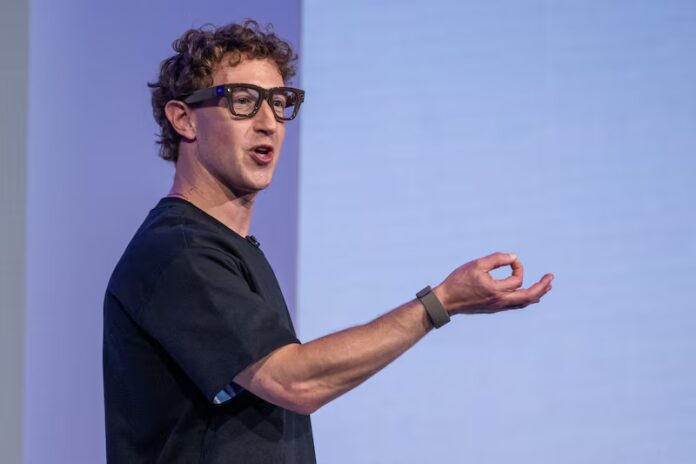

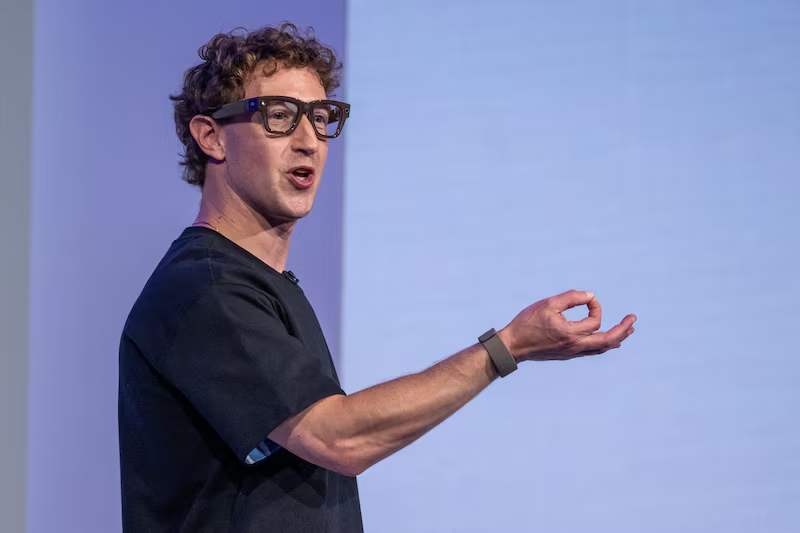

[Digital Business Africa] – In a manifesto published on August 10, 2026, titled The Future is for Everyone, Mark Zuckerberg sets out Meta’s vision for superintelligence. The head of the US technology group advocates for widely distributed, free or affordable personal AI rather than technology controlled by a handful of corporations or governments. He also announces Meta’s forthcoming return to releasing open-source AI models.
Who should benefit from superintelligence? This is the central question around which Mark Zuckerberg builds Meta’s new artificial intelligence doctrine.
In a lengthy statement published on August 10, 2026, Meta’s founder and CEO describes superintelligence as potentially one of the most important technological advances in history. However, he argues that its impact will depend primarily on how this power is distributed.
“The defining questions of our age are who will have access to superintelligence and what we will direct it towards. Will it be centralized and restricted to a few institutions, or will it be a tool that empowers everyone?” the Meta CEO asks.
His answer rests on three principles: individual empowerment as a source of prosperity, invention as the main purpose of superintelligence, and a balance of power as the foundation of safety.
A Personal Agent for Every User
Mark Zuckerberg says Meta is working on personal agents capable of understanding each user, their goals and the things they care about.
According to his vision, these agents will operate continuously to support users in several areas, including health, personal relationships, careers, finances, household management, hobbies and learning.
They could, for example, monitor sleep, provide advice during exercise, suggest personalized recipes, order ingredients or help users quickly test a product idea.
Meta also plans to make these agents available across several devices, including its connected glasses and augmented reality products.
Zuckerberg promises a fully private mode in which even Meta would be unable to view users’ information or grant anyone else access to it. He compares this approach to the end-to-end encryption provided by WhatsApp.
“People will not adopt agents if they do not trust them with sensitive details and tasks,” he acknowledges.
Tools to Create Businesses and New Jobs
Meta’s CEO believes that the greatest contribution of superintelligence will not be automation, but invention.
Early generations of artificial intelligence mainly answered questions and carried out repetitive tasks. Future systems, he argues, will help generate new knowledge, develop medicines, design products and build businesses.
With these tools, individuals or very small teams could launch ventures that currently require significant financial and human resources.
Zuckerberg therefore expects new professions and business models to emerge, including one-person studios designing customized toys, furniture or clothing; world builders and experience designers creating games, stories and adventures; and specialists using AI to develop personalized medical treatments.
He rejects the idea that artificial intelligence will necessarily lead to an overall decline in employment. Instead, he argues that AI could expand people’s capabilities as quickly as, or even faster than, it automates existing activities.
“The more superintelligence serves as a tool of invention, the more likely it is that individual capability will outpace automation,” he writes.
The average size of companies may shrink, but their number could increase. Small businesses would therefore remain the backbone of the economy while becoming capable of producing a much greater impact.
A PhD-Level Tutor in Every Subject
Meta also wants to deploy superintelligence in education.
Zuckerberg envisions a personalized tutor or coach with PhD-level expertise in every subject and unlimited patience.
Students could receive support tailored to their difficulties, including those whose families cannot afford private tutoring. Adults, meanwhile, could learn new professional skills, languages, hobbies or any other subject of interest.
In science, Meta wants to provide researchers with models capable of testing hypotheses over several weeks or months.
Zuckerberg points to Biohub’s work on virtual cells and proteins. These open-source biological models are intended to support new discoveries and the development of personalized medicines.
Free Versions for Billions of People
The US technology group plans to offer some versions of its personal superintelligence tools free of charge.
These free services are expected to be accessible to billions of people. Users who require additional computing power will be able to pay for greater capacity.
Meta is considering a dynamic auction mechanism that would allocate available computing resources to the uses people collectively consider most valuable, while guaranteeing users the lowest possible price.
The stated objective is to prevent access to superintelligence from being restricted to large corporations, government agencies or the wealthiest individuals.
This issue will be particularly important for African countries, where the cost of connectivity, digital equipment and cloud services still limits access to certain advanced technologies.
The promise of free or affordable superintelligence could promote digital inclusion. However, its impact will depend on the available infrastructure, the cost of Internet access, the languages supported and the commercial terms that are ultimately applied.
Meta Announces the Return of Open-Source Models
Mark Zuckerberg also reaffirms Meta’s support for open-source artificial intelligence.
“Open source is a positive and important force for empowering people and preventing centralization that is detrimental to both safety and the economy,” he argues.
Following the establishment of Meta Superintelligence Labs, the company plans to resume releasing selected open-source models in the near future.
The announcement comes as Meta seeks to reposition its AI strategy against leading American and Asian laboratories.
Zuckerberg argues that widely accessible models can be safer, particularly in cybersecurity. According to him, broad distribution enables more researchers and developers to identify vulnerabilities, strengthen systems and share improvements.
He therefore opposes policies that would severely restrict access to advanced AI capabilities. He nevertheless recognizes the need for legal and safety restrictions when they are genuinely necessary.
A Balance of Power Rather Than a Single AI System
Zuckerberg’s manifesto challenges the idea of a single, centralized superintelligence aligned with a universal set of values.
The technology executive argues that humanity is not a monoculture and that no system can simultaneously reflect the conflicting values and interests of billions of people.
He instead advocates for an ecosystem made up of many personal agents, several laboratories and different models that can compete with and check one another.
To illustrate this idea, he imagines a situation in which only one person has access to a superintelligent lawyer. That person would enjoy an unfair advantage in court. If everyone had access to the same tool, however, justice could become fairer and more efficient.
He applies the same reasoning to cybersecurity and the economy. A superintelligence controlled by a single company could allow that company to eliminate its competitors. A technology accessible to everyone could instead stimulate entrepreneurship and competition.
“There is no such thing as a singular benevolent superintelligence,” Zuckerberg states.
Independent Governance for Meta’s Models
Given the risks associated with superintelligence, Mark Zuckerberg says he does not want to be the sole decision-maker regarding the release of Meta’s future models.
The company is introducing a governance structure that will give its independent board of directors the authority to approve safety criteria for model releases and review whether those criteria have been met.
Zuckerberg encourages other frontier AI laboratories to adopt similar mechanisms. He also supports the creation of an industry-wide version of this governance process.
Meta further proposes that AI laboratories provide governments with intermediate versions, or training checkpoints, of models still under development. Public authorities could use these systems to test their capabilities, strengthen critical infrastructure and anticipate new risks before their public release.
American Leadership at the Heart of the Message
Zuckerberg’s statement also has a significant geopolitical dimension.
He argues that the countries leading the development and deployment of advanced AI will shape the world’s future balance of power.
Meta intends to contribute to US leadership by distributing its models and personal agents to billions of users worldwide.
Zuckerberg calls on the United States to accelerate the construction of data centers, energy capacity and semiconductor infrastructure. He also warns against regulations that could delay the release of American models and give foreign competitors an advantage.
His defense of universal access to superintelligence is therefore accompanied by an explicit desire to preserve the United States’ technological leadership.
“The Future Will Be Created by All of Us”
Through this manifesto, Mark Zuckerberg seeks to position Meta as the leading advocate of widely distributed personal superintelligence.
The project still raises numerous questions, including the energy consumption of data centers, the effective protection of personal data, access costs, dependence on private platforms, biological and cyber risks, and the consequences for employment.
Meta’s CEO acknowledges these risks but argues that concentrating artificial intelligence in the hands of a few actors would pose an even greater threat.
“The future will be created by all of us and will reflect all of our values and perspectives,” he says.
For Mark Zuckerberg, the next technological battle will therefore not be only about the power of AI models. It will primarily concern who is allowed to use them, under what conditions and for what purposes.
By Digital Business Africa