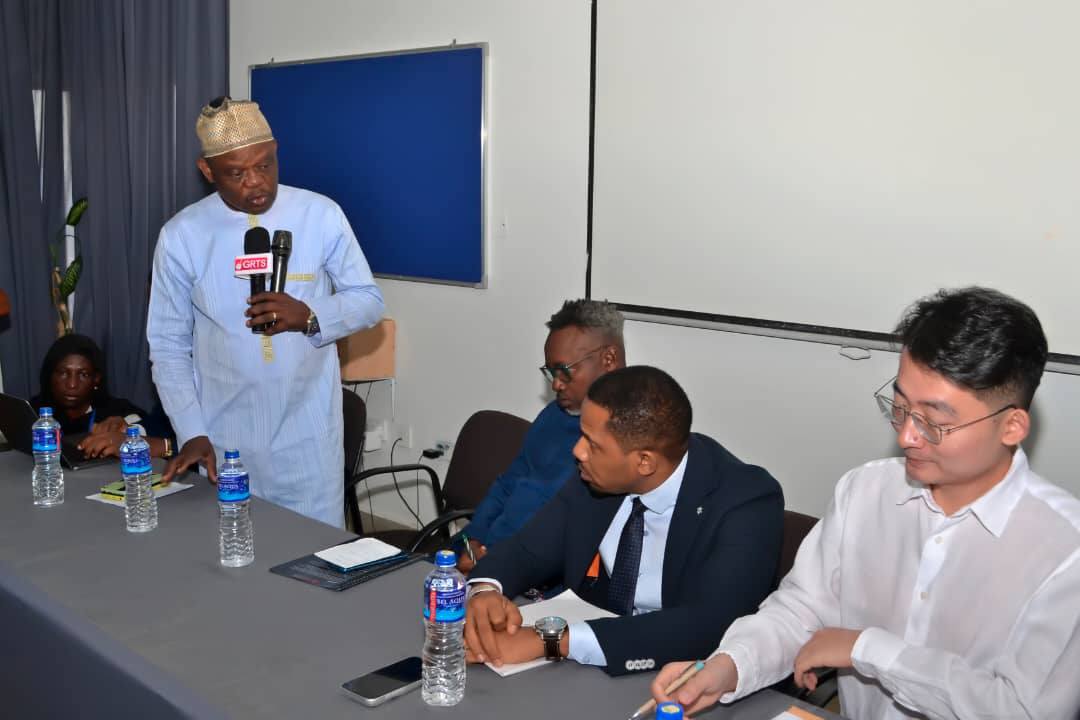
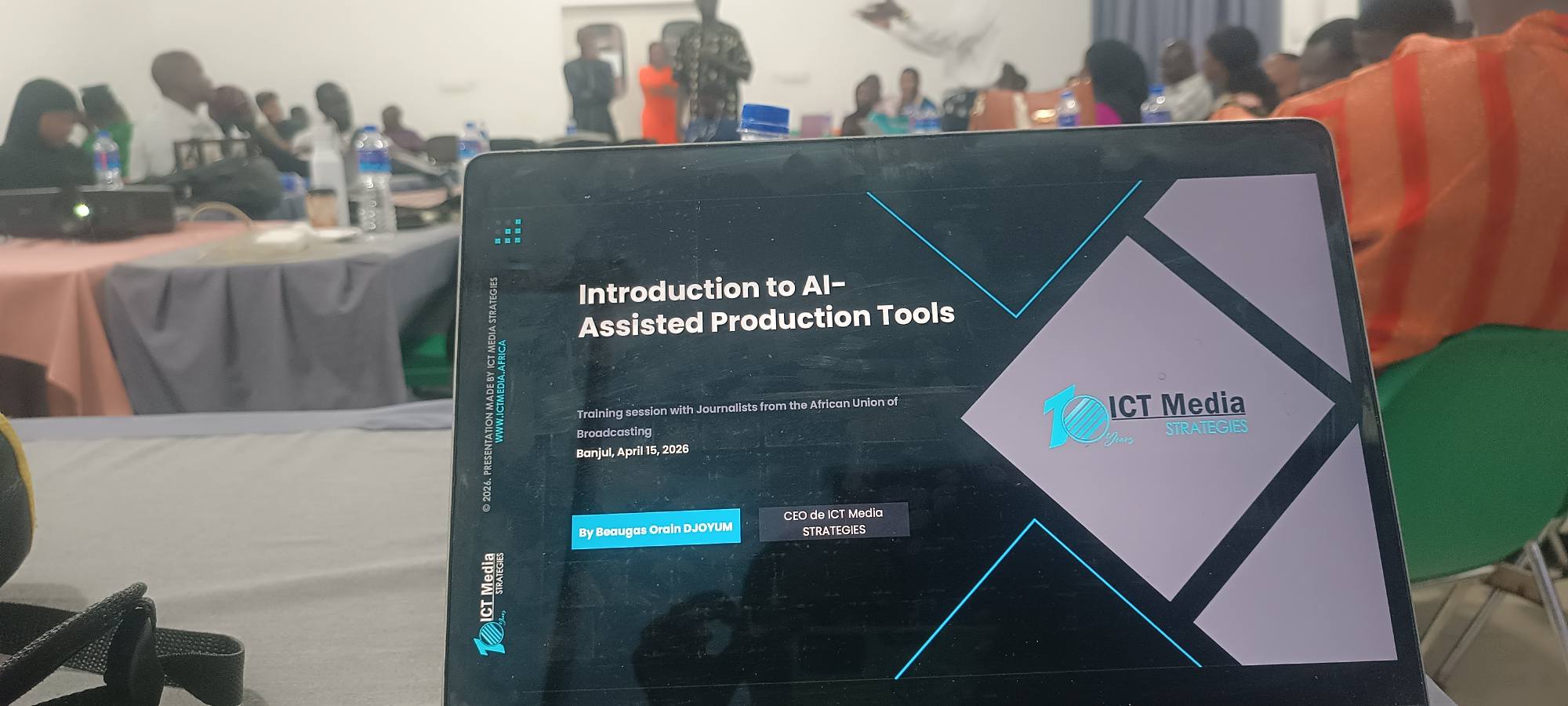
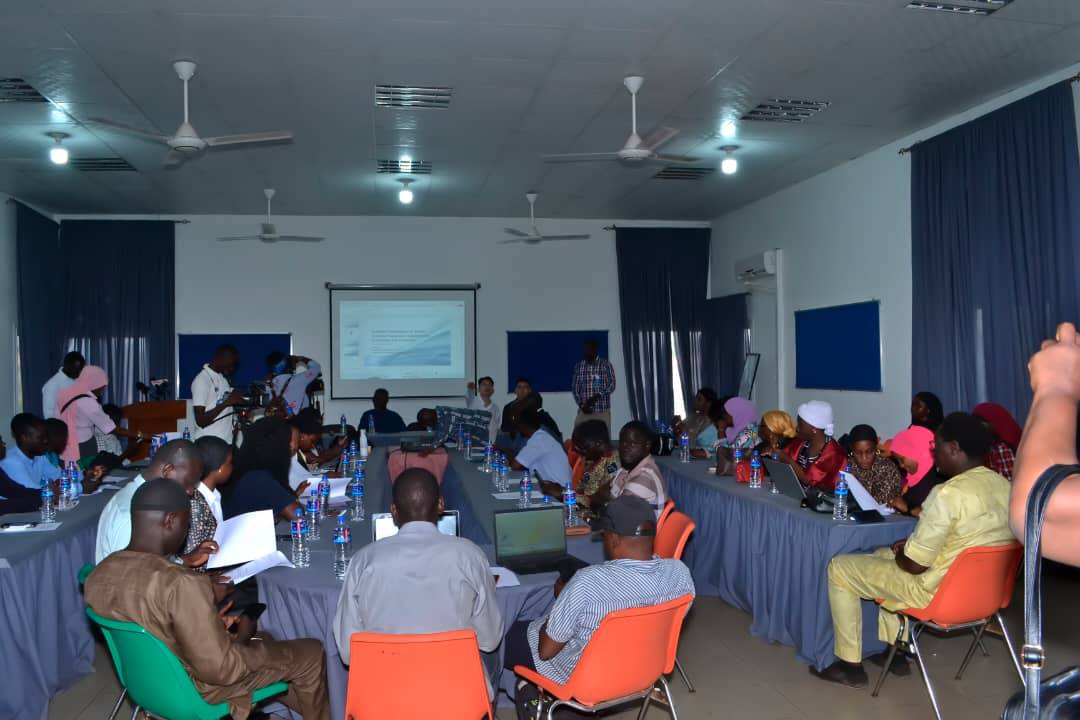
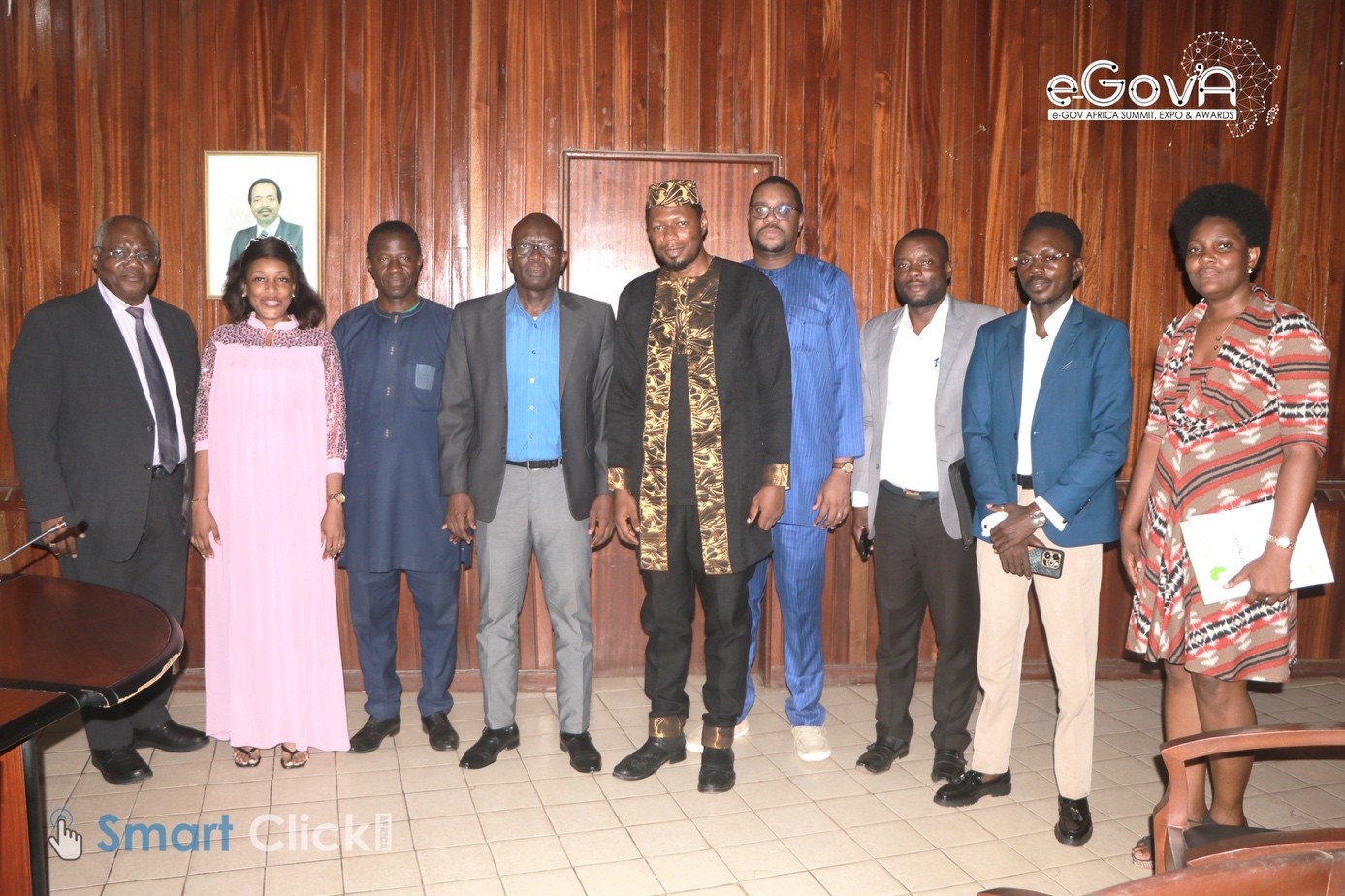
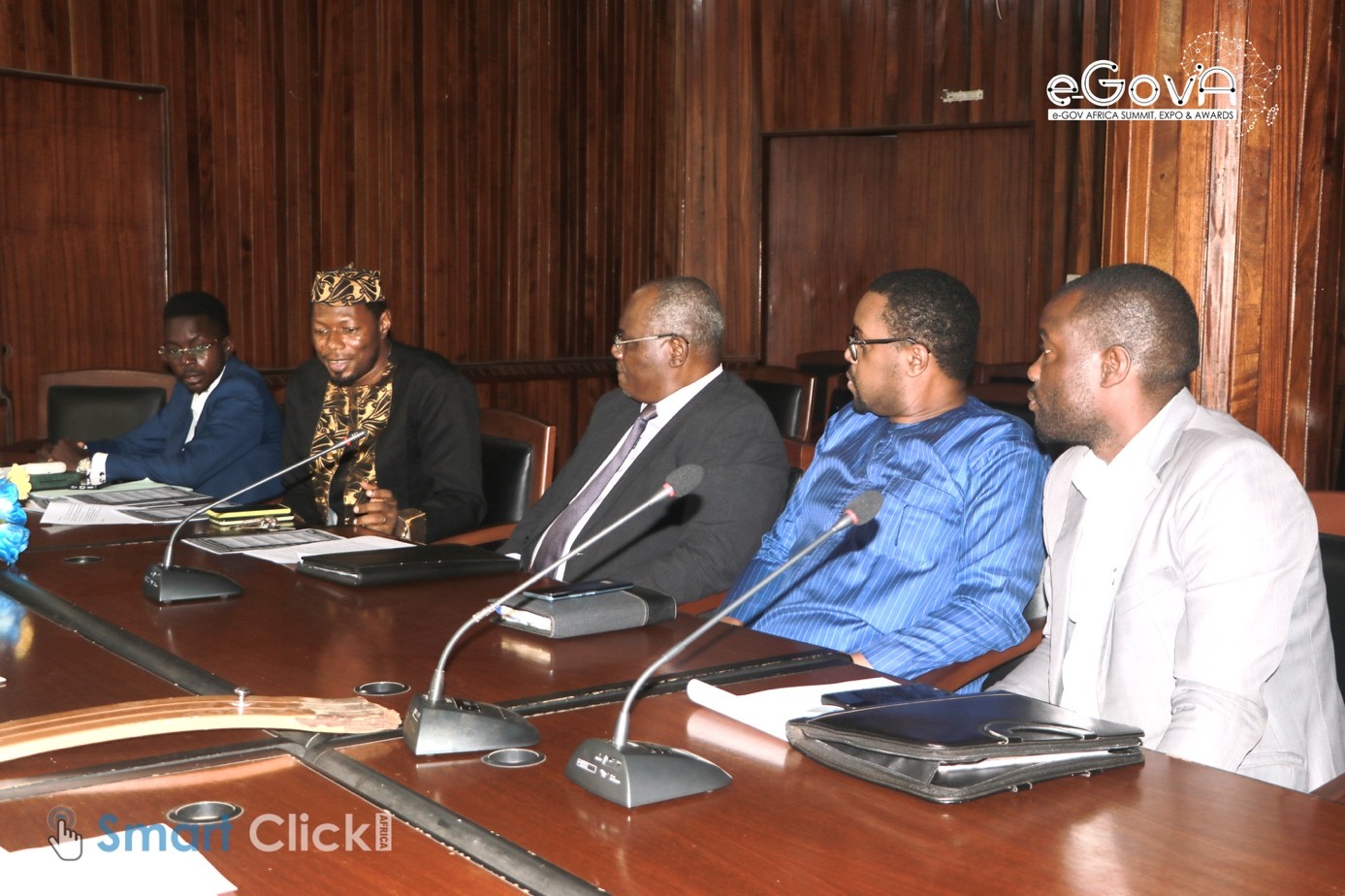
[DIGITAL Business Africa] – The Gambia is positioning itself as a hub for media innovation in Africa by hosting, in Banjul from 14 to 15 April 2026, a strategic training session on artificial intelligence applied to journalism. This initiative is part of the 17th General Assembly of the African Union of Broadcasting (AUB) and marks its 20th anniversary.
Over two days, 60 Gambian journalists were trained by international experts from Cameroon, China, and The Gambia. The workshop was led by Beaugas Orain, CEO of ICT Media STRATEGIES, and Amran Gaye, Founder & CEO of DreamConnect Edu & Travel, alongside two Chinese experts from the National Radio and Television Administration (NRTA), including Leroy Zhang, Global Marketing Manager at the Academy of Broadcasting Science. Haman Mana, Publisher of the newspaper Le Jour, served as facilitator.
In this context, the CEO of ICT Media STRATEGIES delivered the core training modules, combining strong pedagogical and practical value. The first module, titled “Introduction to AI and Journalism,” laid the foundations and emphasised the ethical framework essential to journalistic practice in the age of artificial intelligence.
He then introduced participants to editorial assistance tools through the module “Introduction to AI-Assisted Production Tools: Editorial Assistants; Automation; Information Analysis,” including a specific focus on “How to Use AI Tools to Fight against Deepfakes and Fake News?”. Finally, a third module, “AI-Assisted Media Content Creation: Text, Image, Audio, Video; Editing; Post-production,” provided a hands-on immersion into advanced uses of AI for multimedia content production.
For Dr. Ismaila Ceesay, Minister of Information, Media and Broadcasting Services of The Gambia, the stakes are both clear and urgent:
“Today our journalists and broadcasters face a dual responsibility. The first responsibility is to embrace innovation while defending truth.”
In his opening remarks, the minister highlighted AI’s transformative potential for newsrooms:
“AI can help our newsrooms work smarter. It can also improve audiovisual storytelling. AI can strengthen data journalism. It can automate production processes and improve audience engagement. Essentially, it makes your work easy.” However, he also warned of its risks: “But at the same time, it can also be weaponised through misinformation, deepfakes, manipulated content, and synthetic propaganda.”
The acceleration of the news cycle represents another major challenge.
“Now, news breaks first on digital platforms, even before it reaches our TV,” he noted, adding: “Falsehoods travel faster than facts, and artificial intelligence is increasingly part of this ecosystem. Therefore, this training is timely.”
A similar perspective was expressed by Grégoire Ndjaka, Director General of the African Union of Broadcasting, who called for the responsible use of these technologies: “What is important is not only knowing how to use artificial intelligence, but also the best practices in this domain.” He added: “If artificial intelligence is well used, it is beneficial for society, but if it is not well used, it can be very harmful to the country.”
At the national level, this initiative is part of a broader transformation of The Gambia’s audiovisual landscape. Abdoulie Sey, Director General of GRTS, sees it as a strategic lever: “This is one of the steps towards the transformation and reformation of GRTS… the hardware has to be changed… the software as well… the mentality, capabilities and the skills of the people working there in general have to be changed.” He emphasized: “How do you do that? By continuous training.”
Speaking as a trainer, Beaugas Orain DJOYUM praised the quality of the exchanges and the commitment of participants:
“It was a real privilege to contribute to strengthening the capacities of Gambian journalists on such a strategic issue as the integration of artificial intelligence into journalistic practice. Through concrete examples and hands-on use of targeted AI tools, we shared methods and best practices aimed at making AI a lever for improving the quality of information.”
He continued by stressing the ethical stakes:
“The key challenge is to ensure that these technologies do not become tools for manipulation or the destruction of the reputation of institutions, brands, and individuals, but rather powerful instruments serving truth, verification, and the fight against misinformation. I would like to thank the Director General of the AUB for this opportunity, which allows me to share this expertise at the African level.”
Beyond The Gambia, this training reflects a broader trend across the continent: the gradual integration of artificial intelligence into media ecosystems. Amid opportunities to optimise editorial processes and risks associated with misinformation, African media are now called upon to strike a balance between technological innovation and editorial responsibility.
In this context, initiatives like this resonate strongly with the objectives of E-Gov’A 2026, to be held in Yaoundé, which will highlight the intersections between artificial intelligence and governance in building efficient public services in a “cashless, paperless, seamless” Africa.
[Digital Business Africa] – During the 14th WTO Ministerial Conference in Yaoundé from 26 to 29 March 2026, Brazil emerged as the primary counterbalance to US demands to make the moratorium on electronic transmissions permanent. While the United States advocated for an unlimited extension to safeguard its digital giants, Brasília argued for a more cautious approach centred on development and the fiscal sovereignty of developing countries.
While a minimal compromise seemed achievable on Sunday, Brazil blocked the text on the moratorium to protest US demands and the lack of progress on agriculture. Brazilian Foreign Minister Mauro Vieira stated:
“Agriculture is the sector that has seen the least progress in the WTO’s 30 years of existence. We cannot allow this to continue.”
A Development-Focused Stance
In its official communication to WTO members one week before MC14, Brazil recalled that the digital divide persists and that disparities are exacerbated by the ongoing technological transformation. For Brasília, it is essential to have new empirical analyses on the moratorium’s impact:
– on policy space for industrial development,
– on innovation ecosystems,
– on tax revenues,
– and on the development of domestic digital and creative industries.
A Limited, Not Permanent, Extension
Brazil expressed support for a temporary extension of the moratorium until the next ministerial conference but rejected the idea of a permanent extension. It emphasises the need not to include digital content within the scope of the moratorium, in order to preserve the ability of states to tax certain digital services if necessary.
Hence, its proposal: “We further agree to maintain the current practice of not imposing customs duties on electronic transmissions until our next session, while reaffirming the importance of continuing to reflect on the effects of this practice on the policy space and fiscal capacities of developing and least-developed country Members. In this regard, we also urge that discussions within the WTO on the development of a balanced, development-oriented regulatory framework applicable to digital commerce progress, as well as discussions on ways to ensure that the benefits of the digital economy are more widely shared and that developing and least-developed country Members are better able to participate in and benefit from digital trade.”
An Institutional Proposal
Brasilia also proposed the creation of a Committee on Digital Trade and Emerging Technologies within the WTO. This committee would have the mandate to:
– institutionalise the Work Programme on Electronic Commerce,
– promote digital industrialisation,
– foster inclusive participation by developing countries,
– and bridge persistent digital divides.
“Brazil is of the view that establishing a Committee on Digital Trade and Emerging Technologies could ensure institutional stability for the work carried out so far under the Work Programme; this committee could serve as a forum for dialogue and cooperation on policies related to electronic commerce, digital trade and emerging technologies, with an emphasis on the development dimension,” proposed the country of Lula da Silva.
A Counterweight to the United States
By opposing Washington, Brazil supported a balanced, development-oriented vision, refusing to let the WTO permanently establish a moratorium that mainly benefits US multinationals. This stance contributed to the failure of negotiations in Yaoundé, but it shows a desire to prioritise the interests of developing countries in discussions on global digital governance.
Therefore, Brazil does not oppose the moratorium but opposes its continuation. It seeks an institutional framework that accounts for the fiscal and industrial realities of developing countries and rejects US pressure to embed an exemption from customs duties on electronic transmissions.
[Digital Business Africa] – The high-level discussions of the World Trade Organisation (WTO), held in Yaoundé, concluded this Monday at 2 a.m. with no major breakthroughs after two lengthy ministerial sessions. The 14th Ministerial Conference (MC14) was characterised by the inability of the 166 members to extend the moratorium that, since 1998, had exempted cross-border electronic transmissions from customs duties. Participants agreed to continue discussions in Geneva on a precise but undisclosed timeline.
This moratorium, a key element of global e-commerce, expires tomorrow, 31 March 2026, following the decision taken at MC13. With no agreement in Yaoundé on its extension, a unique situation arises. While this does not mean tariffs will be imposed immediately, the failure represents a significant setback for developed countries and the United States in particular, which pushed for its permanent renewal and threatened to leave the WTO or declare its demise if it was not renewed.
Before MC14 began, U.S. Ambassador Joseph Barloon stated that maintaining the moratorium would give the United States the necessary confidence to “remain fully engaged” in the WTO. Another American diplomat, cited by Reuters, warned: “If Jamieson Greer (the 20th United States Trade Representative) leaves Yaoundé without a moratorium, U.S. proclamations about the death of the WTO will be even stronger.”
By advocating for a permanent extension of the moratorium, the United States continues to safeguard its digital dominance. This enables its companies to offer services without tariff barriers, thereby undermining the fiscal capacities of developing nations. Donald Trump, consistent with his protectionist and transactional stance, views any weakening of the moratorium as an assault on American economic interests. Consequently, he has threatened to withdraw or declare the “death of the WTO” if it is not extended.
Response from the WTO Director-General
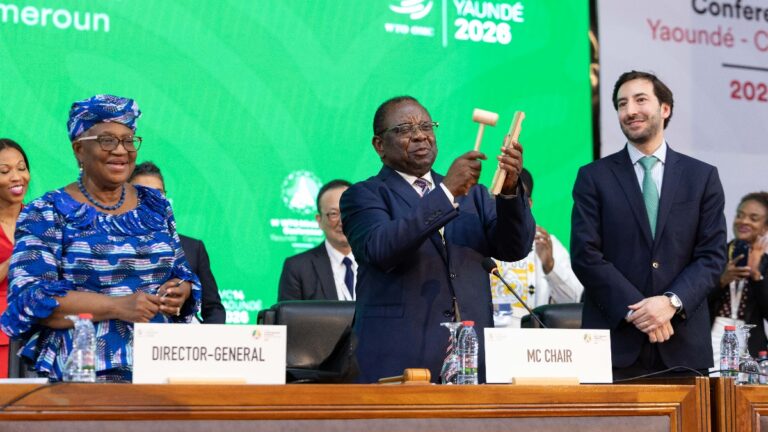
Asked by Digital Business Africa about the interpretation of these threats, given that the moratorium was not extended, Director-General Ngozi Okonjo-Iweala downplayed the situation.
“Members often take firm positions before a ministerial. That’s the art of negotiation, isn’t it? Sometimes, everyone holds their ground, and the goal is to find common ground. Sometimes we succeed, sometimes we don’t. In this case, we had nearly reached a compromise. Members had identified a new landing zone, different from what we used before, not an automatic extension. There are still a few members to persuade, including the United States, which was present and expressed a willingness to continue negotiations.”
Implications for Developing Countries
With no agreement in Yaoundé, developing countries can now demand and collect customs duties on electronic transmissions. This could boost the finances of these states that are constantly seeking to expand their tax base.
Since 1998, the moratorium has prohibited WTO members from imposing customs duties on cross-border digital flows. Its expiry opens the door to discussions on international digital taxation, particularly for African countries seeking fiscal sovereignty.
Historical Context: Seattle 1999 and Doha 2001
Ngozi Okonjo-Iweala points out that this is not the first time the moratorium has expired. In 1999, during the Seattle Ministerial Conference, members failed to agree on its extension. The moratorium had therefore temporarily expired before being reinstated two years later, in Doha, in 2001. This sequence demonstrates that the failure to extend does not automatically result in the imposition of customs duties but rather creates a zone of uncertainty.
If Customs Duties Were Applied…
If customs duties were to be imposed in some developing countries, they would concern solely cross-border electronic transmissions – i.e., digital data flows crossing borders via the Internet.
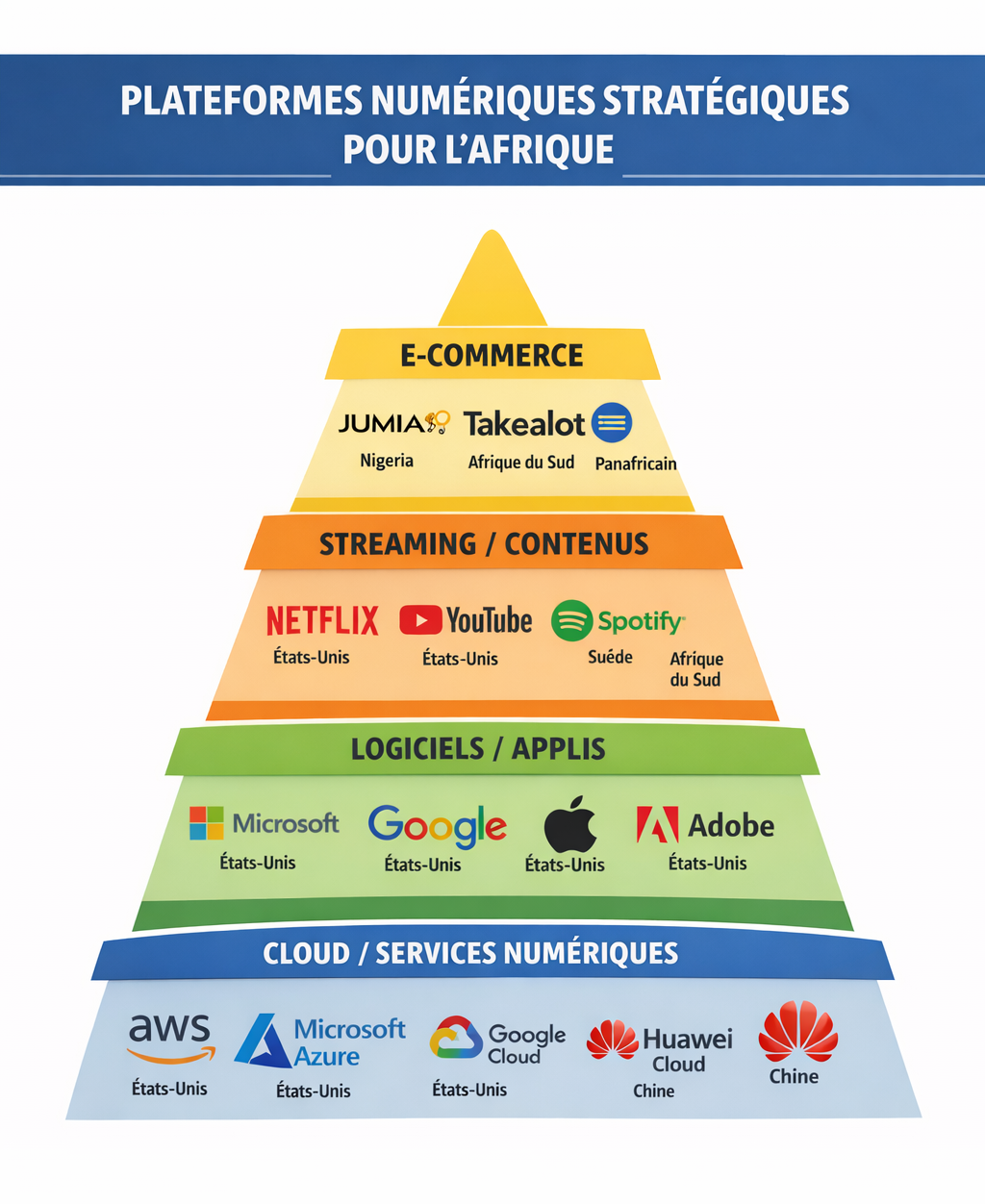
Taxation could take two forms: either through telecom operators (ISPs), who would be responsible for measuring and billing the volume of imported data, or through major digital platforms (Netflix, Microsoft, Google, AWS, etc., see illustration below), which would need to declare the value of the content transmitted and pass the cost on to end users.
Digital platforms are likely to collect customs duties if the moratorium on electronic transmissions is not extended.
In both cases, the goal would be to target the electronic transmission channel itself rather than the digital content.
However, the technical and political challenges would be significant: differentiating cross-border flows from domestic ones, maintaining traceability without compromising Net Neutrality, preventing excessive cost hikes for consumers and local SMEs, while managing diplomatic tensions with the United States.
In other words, taxing electronic transmissions would not be just a financial measure but a strategic decision that impacts digital sovereignty and the balance of international trade relations.
The Brazil-India Barrier vs. The United States
The United States aimed to make the moratorium permanent, but several developing countries, notably India, opposed it, fearing a loss of tax revenue. Brazil, for its part, did not want to extend it beyond two years.
Although a minimal compromise seemed possible on Sunday, Brazil blocked the moratorium text to protest U.S. demands and the lack of progress on agriculture. Brazilian Foreign Minister Mauro Vieira stated, “Agriculture is the sector that has seen the least progress in the WTO’s 30 years of existence. We cannot allow this to continue.”
A week before MC14, Brazil clearly indicated it was in favour of extending the moratorium until the next MC session, “while maintaining the long-standing practice of not extending it to digital content and allowing additional time to continue examining the economic and budgetary implications of the moratorium.”
On the Indian side, Abhijit Das, an international trade expert, head of the Centre for WTO Studies at the Indian Institute of Foreign Trade, and UNCTAD officer in India, explained to Digital Business Africa the reasons behind India’s opposition.
“India’s position is that we will oppose the moratorium because it hinders governments’ ability to generate revenue. REMEMBER, THESE ARE CUSTOMS DUTIES. INDIA BEARS THE NEGATIVE CONSEQUENCES, AS DO MANY OTHER DEVELOPING COUNTRIES. MAKING THIS MORATORIUM PERMANENT WOULD FORCE DEVELOPING COUNTRIES TO GIVE UP A CRUCIAL REVENUE SOURCE IN THE FUTURE”
An Atmosphere of Tensions and Disagreements
For nearly three decades, every WTO ministerial conference has renewed the moratorium. Its expiry in Yaoundé signifies a change. Even though Ngozi Okonjo-Iweala downplays this, noting that it had already been suspended in 1999 before being reinstated in 2001.
Beyond e-commerce, ministers failed to progress WTO reform. The organisation, weakened by political deadlock and the rise of protectionism, is struggling to reinvent itself.
At the press conference, Ngozi Okonjo-Iweala recognised the widespread disappointment: “We worked hard… We simply ran out of time.”
The head of the International Chamber of Commerce, John Denton, expressed his concern: “The failure of WTO members to reach a concrete political agreement in Yaoundé is particularly worrying at a time of real tension for the global economy.” For his part, UK Trade Secretary Peter Kyle called it a “major setback for global trade.”
Yaoundé: Theatre of a Global Deadlock
Yaoundé was intended to represent a fresh start for global trade cooperation. It will be remembered in history as the site of a significant deadlock: no agreement on the e-commerce moratorium, and no progress on agriculture and WTO reform.
For Africa, the event carries double symbolic importance: not only is the continent hosting a WTO ministerial conference for the second time, but it is also at the centre of global trade divisions, caught between the fiscal ambitions of developing countries and the defence of the digital interests of major powers.
After four days of intense debates, the 120 delegations from the WTO’s 166 members – including 80 ministers – leave Yaoundé with a sense of incompleteness, their focus now shifting to Geneva for further negotiations and to Washington, whose reaction will likely influence the future of e-commerce.
What remains now is to observe the follow-up negotiations in Geneva, as well as the United States’ and Donald Trump’s reactions, who view this failure as a strategic setback and a direct threat to American digital hegemony…
By Beaugas Orain DJOYUM
Box: Difference Between Electronic Transmissions and Digital Content
Category
Definition
Concrete Examples
Coverage by the WTO Moratorium as of March 31, 2026
Electronic Transmissions
Cross-border data flows that pass over the Internet or digital networks, without physical support.
– Downloading software from a foreign server
– Streaming a movie or song
– Transmitting an e-book
– Software updates
– Electronic documents sent by email
✅ Yes — the moratorium prohibits imposing customs duties on these data flows
Digital Content
The digital good or service itself is once transmitted and consumed locally.
– The downloaded or streamed movie
– Music purchased online
– The installed software
– The video game or mobile app
– The e-book read on a tablet
❌ No — the moratorium does not cover the content; states can apply VAT or local taxes
Understanding the Moratorium:
The WTO moratorium protects only the transmission channel (cross-border data flows).
Countries retain the freedom to tax digital content (movies, software, music, etc.) through domestic taxes (VAT, digital services taxes).
Brazil, India, and some developing countries insist on this distinction to prevent the moratorium from becoming a permanent tax exemption benefiting major global digital platforms.
After March 31, 2026, in the absence of an agreement to extend the moratorium, WTO member countries can both impose customs duties on electronic transmissions and apply VAT or local taxes on digital content.
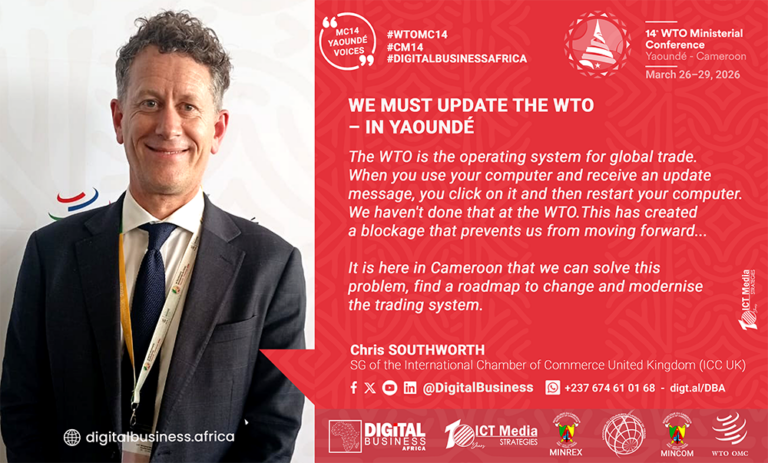
[Digital Business Africa] – Chris Southworth is the Secretary General of the International Chamber of Commerce United Kingdom (ICC UK). He is a recognised expert in trade policy and digital trade. He is co-founder of the UK Centre for Digital Trade and Innovation, ICC’s representative to the Commonwealth, and a member of the ICC Global Council. He is in Yaoundé for the WTO MC14.
In this interview with Digital Business Africa, he highlights the various issues hindering the global and African economies and the actions the WTO and individual countries must take to catch up.
Digital Business Africa: Does the 14th Ministerial Conference (MC14) represent a turning point for the future of the World Trade Organisation (WTO)?
Chris Southworth: Yes. It is a moment of growth for the World Trade Organisation and the multilateral trading system. The truth is that trade has lifted one billion people out of poverty. We live in the 21st century with modern technology. The WTO rules do not reflect the world we live in, nor consumers, nor trade, but especially trade. The global economic order is evolving, which creates geopolitical tensions. But there are also demographic changes, particularly in Africa. The production and consumption base has changed dramatically over this time.
This is a very important moment for all governments, which must unite around the idea of updating the system. The best way to understand it is to compare it to a computer. The WTO is the operating system for global trade. When you use your computer and receive an update message, you click on it and then restart your computer. We haven’t done that at the WTO.
This has created a blockage that prevents us from moving forward. We are not solving the problems of the past. It is here in Cameroon that we can solve this problem, find a roadmap to change and modernise the trading system.
Digital Business Africa: What are the other issues that, in your view, undermine the functioning of the WTO?
Chris Southworth: Despite lifting one billion people out of poverty, mainly in the Global South, which is great, there has been a huge political backlash in the Global North, because living standards have declined significantly over the past 10 to 15 years.
That is why you now see major political trends. Look at America, and, in particular, at Europe: there is very little political support for multilateralism. People want to act unilaterally to protect their own voter bases, consumers, and economies. We need growth. We need to be competitive. We need to raise living standards. The World Trade Organisation sets standards.
In one part of the world, that has been beneficial. In the other, it has not. Now, it is about creating a higher playing field. That is one of the issues. Another observation: economies that were small are now larger than they were back then.
Look at India: it is larger than France. China is now number two. It was not number two 20 years ago. The system does not reflect these changes. Many countries are now developed.
This creates a lot of friction in the system regarding how to ensure that development happens fairly for everyone. The third issue relates to the changing global economic order. The most powerful players in the world are now completely different.
There is a significant power shift from the United Kingdom towards the West and large blocs of countries. Africa is one of these. Africa’s influence is much greater than it was 20 years ago. The same is true in Asia. Therefore, the players in the global system are very different from those of the past.
It is no longer just the G7. It is much more complex. This creates a lot of friction as this change unfolds. It is not that change is bad, but it is change, and the WTO system does not reflect it.
Digital Business Africa: What role does digital play within the WTO system?
Chris Southworth: Digital influence is vital. This is not a technical project. The trading system has remained largely unchanged for 200 years. The documents that businesses complete when crossing borders or exchanging finances are the same as those from two centuries ago. It is all paper-based. There are 4 billion pieces of paper circulating within the system. It is highly bureaucratic. It is slow, inefficient, and costly.
And of course, we are using all modern technologies. The system itself is simply not suitable for the needs of modern business. That is the critical issue with digital. It means we need to make a major transition from paper to the digital economy, where we know that businesses do not transition in 2 to 3 months, but in 1 hour, 1 minute. That is a drastic shift towards a simpler, faster way.
We know that the benefits for everyone, especially small businesses, are immense in terms of efficiency, growth, and access to finance. These are key issues we aim to solve. And naturally, the most straightforward solution is to digitalise the trading system.
But we need to move much faster than we are at present. Currently, it is too slow and does not meet business needs. We all want to be competitive. We must be agile in today’s world, where we face tariffs, export controls, and sanctions. The system is very complex.
Digital Business Africa: What is your view on the digitalisation of businesses worldwide?
Chris Southworth: Digitalisation enables businesses to move faster through transit, access more working capital, and be more liquid than they appear on paper, where all the money remains tied up in the export chain. Digitalisation is a key solution. That’s why it’s so important. But we must ensure it benefits everyone. It cannot be limited to major economies alone. We must do it with everyone.
It is in our interest to be collaborative, but we must improve the rules. We need to establish the digital infrastructure required everywhere, not just in certain regions of the world. Otherwise, people will be left behind, which is the very opposite of what we all aim to achieve.
We aim to elevate living standards, boost economies, and become more resilient in a modern environment. And digitalisation is entirely the solution.
Digital Business Africa: What are the risks for global growth in the event of a slowdown in progress?
Chris Southworth: This is a good moment to think about that. For example, Europe is highly unstable politically. From a business point of view, stability and predictability are crucial. Without stability, investment will not happen, resulting in no jobs, no growth, and no prosperity.
The more unstable the political climate, the harder it is for businesses to expand. However, if growth stalls, the pressure on governments to foster economic development becomes intense. This leads to more frequent changes in housing, public services, and jobs—not only in some regions but across all areas.
It is more politically complicated. This makes it harder for businesses to invest. Ultimately, it leads to inflation, rising costs, increased complexity, and also impacts consumers. When consumers face higher costs, businesses encounter more complexity and expenses. We all suffer, and that is not in our best interest.
We need to collaborate with politicians to enhance political stability. Growth is essential to compete and develop simultaneously while staying stable and prosperous.
[Smart Click Africa] –Yaoundé, 23 March 2026 – The Organising Committee of E-Gov’A – the African e-Governance and Digital Innovation Summit and Expo –, announces the rescheduling of its 2026 edition, initially planned for 14–16 May, to new dates: 14–16 October 2026, at the Yaoundé Conference Centre, Cameroon.
Held under the theme: “Artificial Intelligence and e-Governance: Building Efficient Public Services in a Cashless and Paperless Africa,” E-Gov’A 2026 aims to bring together public administrations, institutions, development partners, and digital ecosystem stakeholders to accelerate the transformation of public services across Africa.
A strategic decision in a dense global and national context
This decision, formalised during a working meeting on 17 March 2026 at the Ministry of Posts and Telecommunications—under whose high patronage the event is held—follows a comprehensive analysis of both national and international calendars.
The decision follows a strategic assessment of the national and international calendar, which reveals a particularly high concentration of major institutional and economic events in Cameroon during the first half of 2026.
This context is expected to place significant demands on governments, development partners, private-sector actors, and the media, potentially limiting participation, visibility, and overall impact.
Rescheduling the event to October ensures optimal conditions for stakeholder engagement, resource mobilisation, and international participation.
October 2026: a stronger platform for impact
The new dates are designed to:
maximize participation from governments, international partners, and private sector stakeholders;
enhance media visibility outside peak event congestion periods;
allow for a more ambitious and high-quality program, including exhibitions, policy dialogues, and technical sessions.
A stronger focus on digital skills and talent
Aligned with the academic and professional calendar, E-Gov’A 2026 will also place a strong emphasis on digital skills, talent development, and innovation.
Key highlights will include:
a dedicated “Campus & Digital Skills Africa” pavilion for IT schools and training institutions to showcase their programs and solutions.
a National Digital Talent Day (October 15);
a student hackathon focused on public sector innovation.
A leading platform for Africa’s digital public transformation
E-Gov’A is positioned as a leading pan-African platform to:
advance digital transformation of public services;
foster public-private partnerships in GovTech and digital infrastructure;
promote innovative solutions (AI, digital payments, digital identity, cybersecurity);
strengthen regional cooperation on digital governance policies.
Program highlights: two days of exhibitions, demonstrations, workshops, and high-level conferences (October 14–15), followed by a field visit day (October 16) to key digital transformation projects and institutions.
Call for participation
The Organising Committee invites governments, international organisations, private companies, startups, academic institutions, and development partners to actively participate in E-Gov’A 2026 and help shape the future of digital public services in Africa.
E-Gov’A is the African Forum on e-Governance and Digital Innovation. It aims to support governments and institutions in modernising public services through digital technologies and artificial intelligence, fostering inclusive and sustainable development.
The event is organised by Smart Click Africa association and Digital Business Africa, in partnership with REPTIC (Cameroon Digital Professionals Network) and Cadit (Cameroon Digital Think Tank), under the high patronage of the Ministry of Posts and Telecommunications of Cameroon.
Official Signature
E-Gov’A Cashless. Paperless. Seamless. For more efficient, accessible and interconnected public services.
[Digital Business Africa] – As the 14th WTO Ministerial Conference (MC14) in Yaoundé approaches, tensions are rising around a central issue: whether to maintain the moratorium on customs duties applied to electronic transmissions, in force since 1998.
The United States and a wide group of countries — including Singapore, Switzerland, Japan, Korea, Australia, and several Latin American nations — are officially proposing to keep the moratorium on customs duties on electronic transmissions. They want to extend it, or even make it permanent.
India, for its part, is firmly opposed.
And the outcome of this standoff could determine the future of global digital trade… and that of the WTO itself.
Washington wants a tariff-free global Internet
In an official communication dated 17 March 2026, the United States and its partners state:
“The practice of not imposing customs duties on electronic transmissions has played an important role in the development of the digital economy.”
They therefore call for maintaining the moratorium, defining electronic transmissions as: “any transmission made using electromagnetic means, including its content.”
The moratorium is Washington’s top priority in Yaoundé.
U.S. Ambassador Joseph Barloon summed it up as follows: Maintaining the moratorium would give the United States the confidence to “remain fully engaged” in the WTO.
A diplomat quoted by Reuters warned:
“If Jamieson Greer (the 20th United States Trade Representative (USTR)) leaves Yaoundé without a moratorium, U.S. proclamations about the death of the WTO will grow even louder.”
Trump was already pushing this vision in October 2025
As early as October 2025, Donald Trump announced his intention to establish “a global digital economy free of tariffs and taxes.”
According to Bloomberg, his administration had already secured commitments from Malaysia, Cambodia, and Thailand to support the WTO moratorium.
Washington was even seeking to make it permanent to lock in a global digital order aligned with U.S. interests and the dominance of major tech companies.
India says no: firm, reasoned, and strategic opposition
While South Africa’s position remains unclear, India has confirmed that it will oppose any permanent extension of the moratorium.
An Indian representative, quoted in the minutes of a WTO meeting on December 2, stated:
“We do not support the extension of the moratorium. The development of e-commerce should not be confused with the supposed benefits of the moratorium. The cost of the moratorium is almost entirely borne by developing countries that are net importers of digital products, while its benefits accrue to a few developed countries.”
For New Delhi, the moratorium deprives developing countries of crucial tax revenues, as physical goods shift to digital formats.
India insists:
“A reconsideration of the moratorium is essential to preserve policy space and achieve domestic industrialization.”
And it is not just saying no.
It is proposing concrete actions:
targeted technical assistance on digital literacy and e-commerce skills;
transfer of digital technologies to developing countries and least-developed countries;
an international mechanism to connect digital infrastructure needs with available financing.
In short, no moratorium without a genuine digital development agenda.
The United States responds: taxing digital trade would intensify the digital divide
At the same meeting, the U.S. representative replied:
“Imposing customs duties on electronic transmissions would undermine efforts to bridge the digital divide. It would impose significant administrative burdens and divert resources that could be better used to close that gap.”
Washington, therefore, wants to make the moratorium a cornerstone of the future global digital order.
An explosive reform context
Discussions on the moratorium are taking place in an already tense climate.
Internal WTO documents show that:
the United States wants reforms,
but rejects a detailed work program,
while the EU, the United Kingdom, and China are calling for one.
Ngozi Okonjo-Iweala warns:
“I expect a difficult ministerial conference.”
Ministers will also debate the Most-Favoured-Nation (MFN) principle, which governs 72% of global trade.
Washington considers MFN to be “outdated for this era.”
A major issue for Africa
For African countries, maintaining the moratorium:
reduces the cost of access to technologies;
supports digital startups;
avoids harmful tariff fragmentation;
facilitates integration into global digital value chains.
However, some African governments share India’s concerns: how to compensate for tax revenue losses linked to dematerialisation?
MC14, the first WTO Ministerial Conference held in Central Africa, thus places the continent at the heart of a global debate on the future of digital trade.
Yaoundé, the stage for a battle over the global digital order
With the United States pushing for a tariff-free Internet, India refusing to give in, the European Union seeking to redefine the rules, and China defending multilateralism, MC14 is shaping up to be one of the tensest in recent WTO history.
What is at stake in Yaoundé goes far beyond the technical framework of e-commerce: it is the architecture of the future global digital order that is being shaped.
Digital Business Africa, which you will find at the Yaounde Conference Centre during MC14, will closely follow the negotiations and the reactions of African delegations in the coming days.
[Digital Business Africa] – Just days before the 14th WTO Ministerial Conference (MC14), scheduled to be held in Yaoundé from 26 to 29 March 2026, a group of fifteen countries – including Australia, Canada, Japan, Singapore, Switzerland, the United Kingdom, and Uruguay – is proposing a major evolution in the global governance of digital trade.
Their communication, dated 17 March 2026, calls for the establishment of a WTO Committee on Digital Trade to replace and formalise the Work Programme on Electronic Commerce (WPEC), launched in 1998.
A context marked by digital urgency
For nearly thirty years, the WPEC has studied trade-related issues connected to e-commerce. However, according to the authors of the communication, the programme has been hampered by “procedural issues” that have consumed a significant portion of members’ resources. Meanwhile, digital technologies – especially artificial intelligence – have deeply transformed global trade.
The signatories note that the current WPEC mandate expires either at MC14 or on March 31, 2026, and that the moratorium on customs duties on electronic transmissions also expires on that date. They therefore believe it is necessary to progress to the next stage.
Committee on Digital Trade: an updated framework
The proposal is clear: “We identify the need for a formal WTO committee with an updated, forward-looking mandate” to address the complex issues of global digital trade.
The future Committee would have several key missions:
Institutionalize the WPEC and modernize its mandate
It would become a permanent multilateral forum for dialogue on digital policies, including AI and emerging technologies. The document highlights that it would serve as a space “for dialogue, collaboration, and transparency.”
Strengthen international coordination
The Committee would collaborate with other WTO bodies, international organizations, and external stakeholders to better address digital opportunities and challenges.
Reduce the digital divide
A key component concerns developing countries and least-developed countries (LDCs). The text emphasizes the need to “identify gaps in support aimed at reducing the digital divide.” Developed members – and capable developing countries – are encouraged to support others.
Create a joint database on capacity building
The document proposes establishing an international database listing training and capacity-building programmes related to digital trade, particularly for SMEs.
Define terms of reference by 2027
The Committee would be required to submit its terms of reference to the General Council at its first meeting in 2027.
A strong signal for WTO reform
For the signatories, the creation of this Committee would be a “signal of the continued relevance of the WTO” in a world where digital trade is becoming central. It would also represent a concrete outcome for MC14, strengthening the organisation’s deliberative function. A draft ministerial decision has already been submitted in this regard and will be discussed in Yaoundé.
What impact on Africa?
Holding MC14 in Yaoundé gives this proposal particular resonance for the continent. Africa, still marked by significant digital access inequalities, could benefit from:
a more structured multilateral framework to defend its priorities;
improved access to capacity-building programmes;
greater visibility for its digital SMEs;
a platform to influence emerging rules on AI, data, and digital platforms.
For African countries, the stakes are strategic: to actively shape the rules of global digital trade rather than passively adapt to them.
A pivotal moment
The proposal to establish a Committee on Digital Trade marks a decisive step in the evolution of global trade governance. At a time when AI, data, and platforms are transforming value chains, the WTO is aiming to reinvent itself.
MC14 could therefore become a historic moment, not only for the organisation but also for African countries hosting a WTO Ministerial Conference for the first time.
Digital Business Africa, which you will find at the Palais des Congrès during MC14, will closely follow the negotiations and the reactions of African delegations in the coming days.
Every week, somewhere on this continent, a new startup launches. There is a pitch deck. There is a demo day. There is a LinkedIn post with a photo of the founding team standing in front of a banner. Applause. Excitement. The feeling that something is beginning.
And then, quietly, most of them disappear.
Not because the founders lacked talent. Not because the ideas were bad. But because the ground beneath them was never solid enough to build on.
I have spent over a decade in African tech. I have built, invested in, incubated, and buried startups. I have watched brilliant people with real solutions fail for reasons that had nothing to do with their product or their hustle. They failed because the infrastructure they needed to succeed simply did not exist.
And I believe this is the conversation we are not having, honestly enough.
The myth of the missing founder
There is a narrative that Africa’s tech ecosystem is primarily constrained by a talent gap. That, if we just train more developers, produce more MBA graduates, and run more boot camps, the ecosystem will flourish.
Talent matters. Of course it does. But I have sat across the table from hundreds of founders in Cameroon, across Francophone Sub-Saharan Africa, and beyond. The talent is there. The ideas are there. What is missing is everything around them.
When a founder in San Francisco launches a startup, they walk into a pre-built world. Angel networks with established deal flow. Legal firms that understand convertible notes. Accountants who specialise in venture-backed companies. Design agencies that speak the language of product. Mentors who have done it before and can compress years of learning into a single conversation.
When a founder in Buea, Douala or Bamenda launches a startup, they walk into a field. And they have to build the road before they can drive on it.
That is not a talent problem. That is an infrastructure problem.
What I mean by infrastructure
I am not talking about internet connectivity, although that matters too. I am talking about the invisible systems that allow an ecosystem to function.
Capital infrastructure.
In most of Francophone Africa, there is no established culture of angel investing. Local business leaders with capital tend to invest in real estate rather than startups. The result is that founders are forced to chase international investors who often do not understand local markets, or they simply never raise at all. We need homegrown investment networks that believe in local solutions. That is why I started Mountain Angel Network. Not to replace international capital, but to build the layer beneath it.
Knowledge infrastructure.
Incubation is not just office space with wifi. Real incubation means access to people who have navigated the exact problems you are facing. Fundraising strategy. Unit economics. Hiring your first engineer. Negotiating with a government procurement office. Most founders in our region are solving these problems alone, from scratch, every single time. The knowledge exists. It is just not organised or accessible.
Design and product infrastructure.
Too many African startups go to market with products that were built before they were designed. The UX is an afterthought. The brand is a logo someone made in Canva. And then they wonder why customers do not trust them. Product design is not a luxury. It is the difference between a tool people tolerate and a product they choose.
Community infrastructure.
Founders need proximity to other founders. Not for networking in the transactional sense, but for the kind of quiet encouragement that keeps you going when the work is hard and the results are slow. An ecosystem without community is just a collection of individuals struggling in parallel.
The problem with counting startups
We have become very good at measuring the wrong things. How many startups were founded this year? How much venture capital flowed into the continent? How many demo days were held? How many accelerator cohorts graduated?
These numbers feel encouraging. But they are surface metrics. They tell you about activity, not about health.
The questions I am more interested in are harder to answer. How many of those startups are still operating two years later? How many founders had access to legal counsel before signing their first term sheet? How many had a mentor who actually built something, not just someone who gives advice professionally? How many had the financial runway to iterate on their product instead of launching too early out of desperation?
If we measured those things, the picture would look different. And our priorities would shift.
Building the ground, not the building
This is the work I have committed my career to. At Mountain Hub, we do not just accept startups into a program and wish them well. We act as co-founders. We sit in the room for the hard decisions. We provide the services that founders need but cannot afford in the early days: product development, financial planning, legal guidance, and connections to capital.
Through iknite studio , we bring product design and venture-building expertise to startups and corporations alike. Because a good idea without a well-designed product is just a conversation.
Through CITSCM, we create a space each year where the entire ecosystem can gather, share what is working, and hold each other accountable for what is not.
None of this is glamorous work. You will not see it on the cover of a magazine. Building infrastructure never makes headlines the way a fundraising announcement does. But it is the work that makes everything else possible.
A different kind of ambition
I am not interested in Africa producing more startups. I am interested in Africa producing more startups that survive. That grows. That employs people. That solves problems so well that they become essential to the communities they serve.
And for that to happen, we need to stop celebrating launches and start investing in foundations.
We need more people building the boring, essential, unglamorous systems that allow founders to focus on what they do best. We need capital networks that are patient. Incubation models that go deep, not wide. Design thinking is applied before the first line of code, not after. And communities that hold together when the excitement fades, and the real work begins.
Mountains are not built from the peak down. They are built from the bedrock up. And if the bedrock is not solid, nothing that stands on it will last.
That is what I am building. And I believe it is what Africa needs most right now.
[DIGITAL Business Africa] – The British government’s decision on 4 March 2026 to impose a “visa brake” targeting, among others, Cameroon continues to raise questions. Official statistics from the UK Home Office indicate that the Central African country does not rank among the main nationalities applying for asylum in the United Kingdom. Yet London has decided to suspend sponsored student visas for Cameroonian nationals, citing a sharp rise in asylum claims from individuals who entered the country through certain legal migration routes.
Shortly after the announcement, the United Kingdom’s High Commissioner to Cameroon, Matt Woods, said in a statement that “from 26 March 2026, visa applications from Cameroonian nationals under the Student Visa category will be refused under the ‘Visa Brake’ mechanism introduced by the British government for certain visa routes.”
He later explained in a video message that more than 30% of Cameroonians who obtained a student visa over the past two years subsequently applied for asylum, thereby breaching the conditions of their visa.
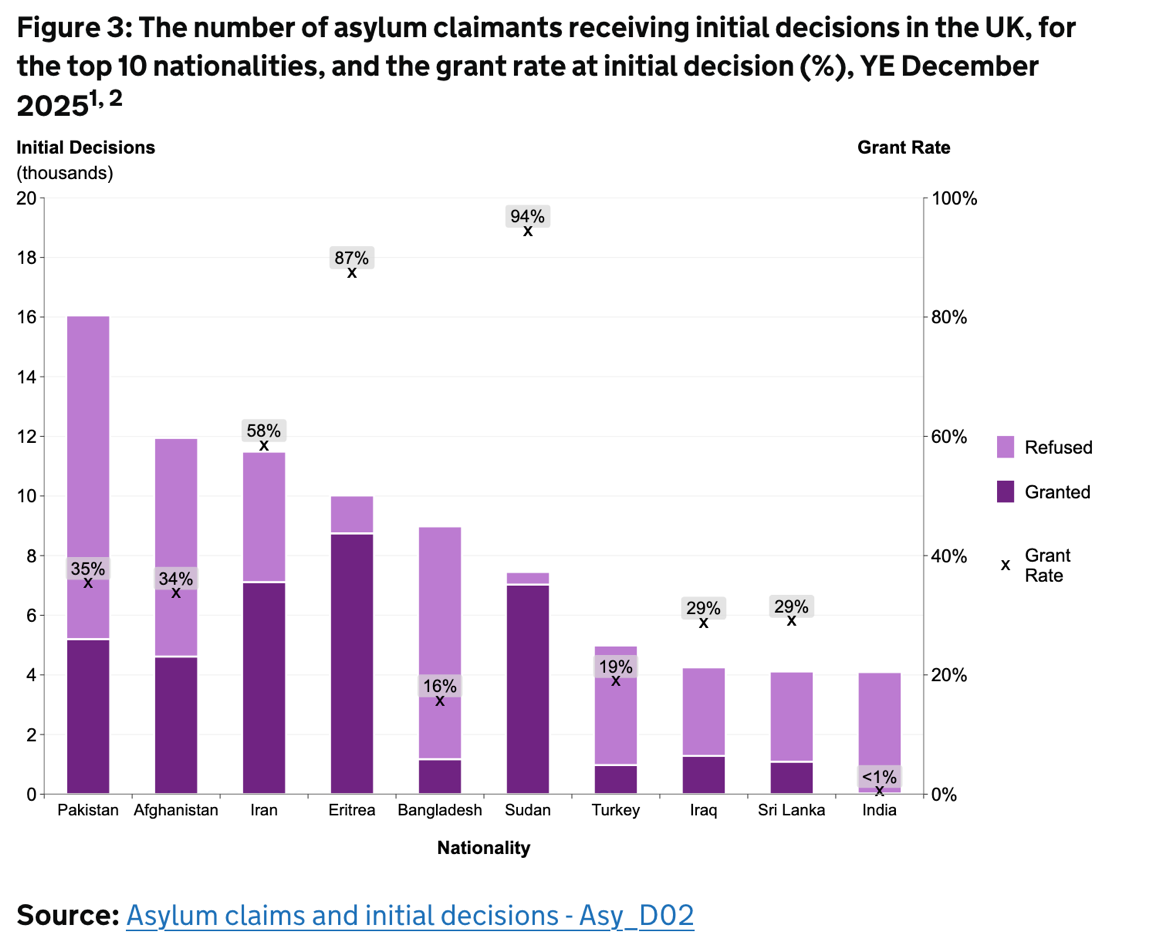
UK Home Office data for 2025 shows most asylum applications are from Pakistan (10,638), Eritrea (8,948), Iran (7,419), and Afghanistan (6,462), with several other countries also exceeding 5,000 applications.
Conversely, Cameroon does not appear in the Top 20 nationalities with the most asylum applications. Cameroonian nationals are grouped in the “Other” category, which includes all nationalities, each of which represents a smaller volume of applications.
This statistical reality raises a central question: why is London targeting Cameroon when its overall weight in asylum applications remains relatively limited?
Top 20 Nationalities Applying for Asylum in the UK in 2025
Rank
Nationality
Asylum Applications
Initial Decisions
Protections Granted
Refusals
Acceptance Rate
1
Pakistan
10 638
16 054
5 201
10 853
35%
2
Eritrea
8 948
10 017
8 748
1 269
87%
3
Iran
7 419
11 487
7 113
4 374
58%
4
Afghanistan
6 462
11 946
4 616
7 330
34%
5
Bangladesh
6 247
8 981
1 174
7 807
16%
6
Sudan
5 869
7 450
7 029
421
94%
7
India
5 751
4 095
23
4 072
0%
8
Somalia
4 777
3 330
1 237
2 093
35%
9
Nigeria
2 904
3 623
856
2 767
28%
10
Vietnam
2 428
3 515
659
2 856
19%
11
Brazil
2 416
1 592
14
1 578
1%
12
Iraq
2 370
4 252
1 284
2 968
29%
13
Sri Lanka
2 243
4 114
1 090
3 024
29%
14
Ethiopia
2 096
2 065
1 189
876
57%
15
Syria
1 959
660
64
596
9%
16
Turkey
1 883
4 988
977
4 011
19%
17
Albania
1 816
1 874
121
1 753
5%
18
Yemen
1 776
2 594
2 506
88
97%
19
Ukraine
1 503
2 040
256
1 784
12%
20
China
1 471
1 717
230
1 487
11%
At the same time, student visas issued to Cameroonians remain relatively modest, hovering around a few hundred per year. Data from the UK Home Office indicates, for example:
Year
Number of Applications
2018
262
2019
262
2020
249
2021
437
2022
520
2023
489
2024
455
2025*
507
A Decision Based on Ratios Rather Than Volume
The explanation provided by the Home Office is not based on the total volume of asylum applications, but on their recent trends and the entry routes used. The British government claims to have observed a sharp increase in asylum claims lodged by people who entered the UK legally, particularly with student visas.
Authorities indicate that student applications from nationals of four countries — Afghanistan, Cameroon, Myanmar, and Sudan — reportedly increased by more than 470% between 2021 and 2025.
According to Home Office statements, student applications from Cameroonian nationals rose by more than 330% over the same period. However, detailed data on the exact number of Cameroonian students who applied for asylum is not published on the UK Home Office website. Digital Business Africa will return to this question in a future article.
Nevertheless, a cross-analysis of Home Office data provides additional insight. Statistics show that the number of asylum applications lodged by Cameroonians already present in the UK — i.e., ‘In Country’ applications lodged by main applicants (students, tourists, workers, or other statuses) — rose from around 101 cases in 2021 to 544 in 2025.
When comparing these two statistical series, a particular phenomenon emerges. In 2024 and 2025, the number of asylum applications lodged by Cameroonians already present in the UK exceeded the number of student visas issued during those same years.
In 2024, for example, 478 ‘In Country’ asylum applications were recorded for 455 student visas issued. In 2025, statistics indicate 544 asylum applications for 507 student visas issued (data available up to September).
This unusually high ratio appears to be one of the main warning signals for the British authorities.
Comparative Table: Cameroon vs. Nigeria Asylum Applications by UK Residents (students, tourists, workers, or other statuses)
Year
Cameroon
Nigeria
2010
80
716
2011
76
657
2012
104
863
2013
111
882
2014
125
860
2015
129
880
2016
147
1130
2017
205
1013
2018
185
802
2019
214
818
2020
102
480
2021
101
490
2022
218
667
2023
167
704
2024
478
1721
2025
544
1846
Cameroon Ratio: Student Visas vs. Asylum Applications
Year
Student Visas
Asylum Applications
Asylum / Visa Ratio
2018
262
185
71 %
2019
262
214
82 %
2020
249
102
41 %
2021
437
101
23 %
2022
520
218
42 %
2023
489
167
34 %
2024
455
478
105 %
2025 (jusqu’en septembre 2025)
507
544
107 %
NB: Asylum applications include all Cameroonians in the UK.
Until 2023, asylum applications remained lower than the number of student visas issued. A cross-analysis of Home Office statistics shows that in 2024 and 2025, the number of asylum applications lodged by Cameroonians already present in the UK exceeded the number of student visas issued during those same years. This unusually high ratio, even on a relatively limited overall volume, could explain the British authorities’ decision to restrict access to student visas for this nationality.
A Striking Contrast with Nigeria
Comparison with other African countries further illuminates the British government’s logic. Nigeria, for example, is one of the main nationalities of students in the UK.
Home Office data indicates that over 58,000 student visas were issued to Nigerians in 2022. Even after a recent decline, the country still accounts for more than 25,000 student visas in 2025 (data up to September).
At the same time, asylum applications lodged by Nigerians already present in the UK remain low. In 2025, there were 1,846 ‘In Country – Main Applicant’ asylum applications for over 25,000 student visas issued, a ratio of about 7%.
Nigeria Ratio: Student Visas vs. Asylum Applications
Year
Student Visas
Asylum Applications
Asylum / Visa Ratio
2018
5641
802
14 %
2019
7027
818
12 %
2020
9876
480
5 %
2021
27011
490
2 %
2022
58673
667
1 %
2023
40869
704
2 %
2024
21109
1721
8 %
2025 (jusqu’en septembre 2025)
25362
1846
7 %
For Cameroon, however, this ratio exceeds 100% in some years, meaning that recorded asylum applications can be comparable to, or even greater than, the number of student visas issued.
Revealing Comparison of Cameroon vs. Nigeria Ratios
Année
Ratio Cameroun
Ratio Nigeria
2022
42 %
1 %
2023
34 %
2 %
2024
105 %
8 %
2025
107 %
7 %
In other words, even if the total number of Cameroonian students in the UK remains low, the proportion of asylum applications among people already present in the country appears significantly higher.
A Transformation of the British Asylum System
This situation is part of a broader transformation of the British asylum system. According to the Home Office, nearly 39% of asylum applications lodged in the UK in 2025 now come from people who entered the territory legally, particularly with student or work visas.
Ministry statistics indicate that in the year ending December 2025, 39,095 asylum applicants held a visa or another form of leave before applying.
Among them:
35% held a work visa
32% held a student visa
19% held a visitor visa
14% held other forms of leave
These figures illustrate a major shift: a growing share of asylum applications now comes from people who entered the UK legally.
Why This Topic Also Concerns the African Digital Ecosystem
Beyond migration issues, this matter also concerns the African tech ecosystem. A significant portion of African students going to the UK choose courses in technology-related fields, including computer science, data science, engineering, cybersecurity, and artificial intelligence.
According to statistics from the UK’s Higher Education Statistics Agency (HESA), international students in the UK are mainly concentrated in fields such as Business and Management, Computing/IT, Engineering, and Social Sciences, which are among the most popular courses in British universities.
For many Cameroonian students, British universities thus represent a pathway to acquiring advanced technological skills that are subsequently valued in the digital, telecommunications, fintech, and innovation sectors.
The British decision to suspend certain student visas could therefore have implications beyond migration issues, also impacting the educational paths of many young Africans in key fields such as technology and digital skills.
This is also why Digital Business Africa, a media outlet specialised in ICT, telecommunications, and innovation news in Africa, is interested in this decision and its possible effects on the development of training and the exchange of digital skills between Africa and major international tech hubs.
A Measure That Raises Questions About the Coherence of Immigration Policy
Despite London’s explanations, the decision still raises questions. While Cameroon has a high ratio of student visas to asylum applications, the overall number remains much lower than that of several other nationalities in the British asylum system.
The question posed thus extends beyond the Cameroonian case alone. Why opt to suspend access to student visas for an entire nationality instead of directly addressing the individual cases where student visa holders seek asylum after arriving in the UK? And why is such a measure implemented while other countries, like Nigeria, continue to send tens of thousands of students to British universities each year?
Beyond the migration debate, this decision reveals a deeper shift: the global politics of education and talent. For twenty years, major Anglo-Saxon universities have become key training hubs for the scientific, technological, and entrepreneurial elites of the Global South.
In this context, student visa policies are no longer solely concerned with the administrative management of migration. They also function as instruments of economic, scientific, and geopolitical policy.
The British decision, therefore, prompts a wider question for Africa: in a world where major powers are gradually tightening their immigration policies, how will countries on the continent continue to train, attract, and retain the technological skills on which their digital transformation depends?
For British universities, African students, and the continent’s emerging digital ecosystems, the evolution of these policies could well herald a new phase in the global competition for talent.
By Beaugas Orain DJOYUM
Also read: …https://www.digitalbusiness.africa/en/united-kingdom-london-suspends-student-visas-for-cameroonians-following-a-surge-in-asylum-applications/
Yaoundé, 28 February 2026. ICT Media STRATEGIES informs the public, its national and international institutional partners, and its wider community that its principal Facebook pages were reactivated on 27 February 2026 following formal engagement with Meta.
The reactivation follows the simultaneous deactivation recorded on 14 February 2026, which impacted six Facebook accounts belonging to members of our team, as well as five strategic pages associated with our editorial, e-reputation, and digital communication activities.
The Facebook pages of Digital Business Africa, ICT Media STRATEGIES, Beaugas ORAIN DJOYUM, and Smart Click Africa are now fully accessible and operational.
Between 14 and 27 February 2026, sustained and constructive dialogue with Meta’s teams enabled the restoration of our core digital assets.
To date, no formal notification of any breach of community standards or platform terms has been communicated to us. Dialogue remains ongoing to finalise the review of two team member accounts and one professional page, Africa Defense, which is still under assessment.
We appreciate Meta’s engagement and the cooperative spirit demonstrated throughout the handling of this matter. We also acknowledge the attention shown by the relevant national authorities, reflecting their commitment to ensuring the stability and continuity of digital activities carried out by professional actors.
As a committed contributor to Africa’s digital transformation, publisher of specialised information platforms, and partner to numerous public and private institutions, ICT Media STRATEGIES remains dedicated to fostering responsible and structured dialogue between global digital platforms and professional content producers. The stability, predictability, and transparency of digital environments are essential to the credibility of Africa’s digital ecosystem and to sustaining user trust.
The continuity of our services and editorial operations is fully ensured. We thank our partners, institutions, clients, and members of the digital community for their continued confidence and support.
ICT Media STRATEGIES, Digital Business Africa, Smart Click Africa, and Africa Defense reaffirm their commitment to delivering reliable, independent, and professional information in support of Africa’s digital economy.
[ICT Media STRATEGIES] – Yaounde, February 20, 2026. ICT Media STRATEGIES, a Cameroonian company specializing in e-reputation (digital communication), strategic monitoring, advisory services, and the publishing of digital platforms dedicated to Africa’s digital economy, hereby informs the public and its partners of a simultaneous and unexplained deactivation of several of its Facebook assets, observed on 14 February 2026.
Five personal accounts belonging to members of the organization, as well as five professional pages—Digital Business Africa, ICT Media STRATEGIES, Smart Click Africa, Africa Defense, and the Beaugas ORAIN DJOYUM Official Page—were deactivated without prior notice. Currently, there is no possibility of appeal through standard channels, as the process requires logging into accounts that are now inaccessible.
Among the deactivated assets is the verified personal account of our Chief Executive Officer, Beaugas ORAIN DJOYUM, which was secured by two-factor authentication.
To date, no explanatory email has been received. This situation is particularly concerning as all affected accounts fully comply with Meta’s Community Standards. The simultaneous deactivation of multiple strategic accounts and pages constitutes an unusual incident, the origin of which remains unknown.
Impact on Activities
This sudden interruption severely disrupts:
The distribution of editorial content to our readers and subscribers;
The publication of information and press releases for our partners;
The continuity of ongoing communication campaigns;
The visibility of our platforms, which are followed by tens of thousands of subscribers.
The temporary unavailability of our Facebook pages, affecting the visibility of our activities and references among our partners and institutional stakeholders.
Actions Taken
As we are unable to access the Meta Help Center, Meta Business Support, the Meta Journalism Project, or Meta Verified Support—all of which require a Facebook login—ICT Media STRATEGIES has initiated official démarches with Meta. We have requested the urgent reactivation of all assets and an official clarification regarding this incident.
The Meta teams we managed to reach have indicated that the situation is currently under review. We are awaiting formal feedback. We remain fully mobilized to ensure business continuity and will continue to inform our partners and community with full transparency. We sincerely apologize to our subscribers, partners, and clients whose scheduled content has been affected.
Service Continuity
Pending a resolution, all our content remains accessible via the following channels:
WhatsApp Channels: ICT Media STRATEGIES and Digital Business Africa (https://digt.al/DBA)
ICT Media STRATEGIES, Digital Business Africa, Smart Click Africa, and Africa Defense reaffirm their unwavering commitment to providing reliable, independent information in the service of Africa’s digital ecosystem.
(é) Beaugas Orain DJOYUM, CEO of ICT Media STRATEGIES
[DIGITAL Business Africa] – Robotics, powered by the rapid advances of artificial intelligence, is moving to a whole new scale. Beyond factories, humanoid robots are now entering public debate as a technology set to profoundly transform economies and societies. On January 22, 2026, in Davos, Tesla and SpaceX CEO Elon Musk delivered a resolutely optimistic vision of this automated future, echoing hard data that confirms the scale of the ongoing revolution.
According to the International Federation of Robotics (IFR), the global stock of industrial robots in operation exceeded 4.6 million units at the end of 2024, with double-digit annual growth. At this pace, analysts expect more than 10 million industrial robots to be in operation worldwide by 2030, while the global robotics market—estimated at nearly $50 billion in 2024—could exceed $200 billion by 2034. These figures reflect a structural shift: robotics is no longer merely a tool for industrial optimization, but is becoming a core infrastructure of the digital economy.
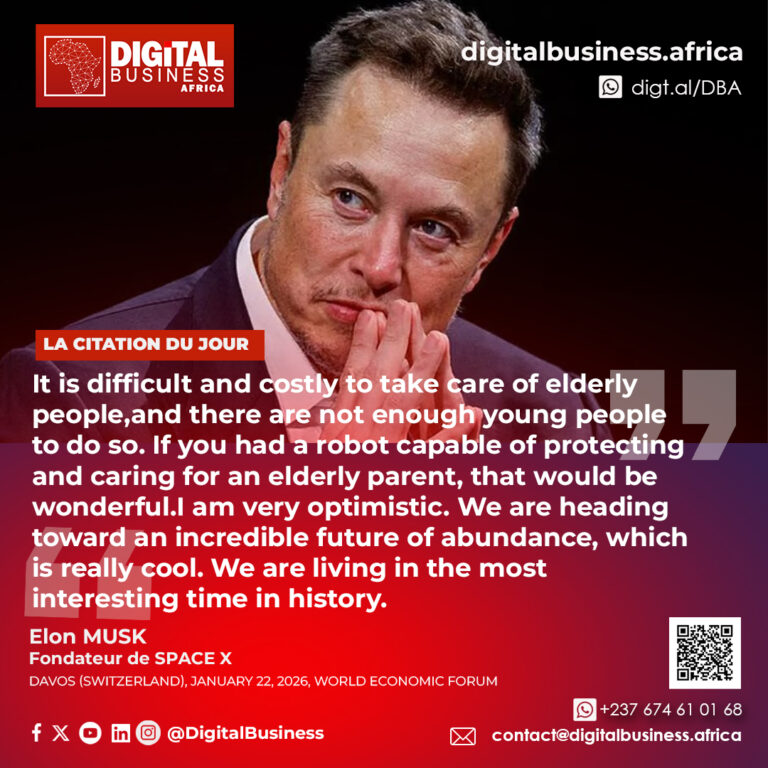
This quantitative trajectory aligns with Elon Musk’s vision of the massive diffusion of humanoid robots throughout society. In Davos, he stated: “There will be billions of humanoid robots, and I think everyone on Earth will have one and want one.” For the American tech leader, these machines will not be confined to factories or warehouses, but will enter domestic and social life. “Who wouldn’t want a robot to watch over their children, take care of their pets, or look after their elderly parents?” he said, sketching the profile of a universal everyday assistant.
Projections of the economic impact of this robotic wave are commensurate with these ambitions. According to several research firms, the integration of robotics and AI could generate trillions of dollars in productivity gains globally over the next decade, particularly in manufacturing, logistics, healthcare, and services. The humanoid robotics segment, still emerging, is itself valued by some investment banks at between $40 billion and $200 billion by 2035, driven by the convergence of advanced sensors, generative AI, and mechatronics.
For Musk, one of the most critical use cases relates to addressing population aging. “It is difficult and costly to take care of elderly people, and there are not enough young people to do so,” he recalled, highlighting a structural challenge shared by many economies. In this perspective, humanoid robots could become care assistants, capable of monitoring, assisting, and protecting dependent people. “If you had a robot capable of protecting and caring for an elderly parent, that would be wonderful,” he added, positioning robotics as a technological response to an emerging social crisis.
This vision is part of a broader philosophy of the Tesla founder, who sees robotics and AI as the foundation of a new model of prosperity. “We are heading toward an incredible future of abundance,” he said in Davos, arguing that intelligent automation is the only credible path to sustainably raising living standards worldwide. He concluded on a near-historical note: “We are living in the most interesting time in history.”
Yet this horizon of “abundance” raises major governance challenges. Massive automation is already reshaping labor markets, with risks of job displacement in low-skilled roles, alongside the creation of new professions in the design, maintenance, and supervision of robotic systems. For Africa, the rise of humanoid robots and AI represents both an opportunity for productive catch-up in industry, logistics, and healthcare, and a risk of widening digital divides if public policies fail to anticipate skills development, regulatory frameworks, and equitable access to these technologies.
Between hard projections and visions promoted by tech giants, humanoid robotics is now emerging as one of the defining markers of the next digital decade. The question is no longer whether robots will transform our economies, but how fast—and under what collective rules.
[DIGITAL Business Africa] – As the 14th Ministerial Conference of the World Trade Organisation (WTO), scheduled for 26 to 29 March 2026 in Yaoundé, approaches, Cameroon cannot limit itself to the role of a purely ceremonial host.
Hosting MC14 imposes a particular political responsibility on Cameroon: to actively contribute to the search for credible compromises on the most sensitive issues in multilateral trade.
The current negotiating context, marked by sharp divergences on electronic commerce and on the moratorium on customs duties applicable to electronic transmissions, calls for a structured, credible and, above all, operational positioning. This responsibility requires Cameroon, through its relevant administrations, to take concrete steps to advance its proposals at the earliest opportunity at the next meeting of the WTO Work Programme on Electronic Commerce, scheduled for 2 March 2026 in Geneva.
Substantively, the WTO debate is now crystallising around two major fault lines. The first concerns the orientation of the Work Programme on Electronic Commerce, which is viewed as insufficiently operational in addressing development challenges. The second concerns the moratorium in place since 1998, regularly extended but increasingly contested due to its fiscal implications.
A debate now framed by a clear deadline set by ministers at MC13
This debate is also taking place within a political and legal framework that WTO ministers clearly defined at the 13th Ministerial Conference (MC13), held in Abu Dhabi from 26 February to 2 March 2024. In their Ministerial Decision on the Work Programme on Electronic Commerce, adopted on 2 March 2024, ministers agreed to continue reinvigorating the Work Programme, with particular emphasis on its development dimension, taking into account the economic, financial and development needs of developing and least developed countries.
Most importantly, ministers explicitly decided to maintain the practice of not imposing customs duties on electronic transmissions only until the 14th Ministerial Conference or until 31 March 2026, whichever is earlier, stating unambiguously that the moratorium and the Work Programme will expire on that date.
This decision marks a major turning point. For the first time since 1998, the moratorium extension is no longer automatic or open-ended, but is explicitly time-bound. Ministers also requested that discussions be deepened on the scope, definition and impact of the moratorium, drawing on empirical evidence, notably in relation to development, digital industrialisation, and the ability of developing and least-developed countries to “level the playing field” in the digital economy.
It is therefore within this specific context—of a programmed end-date for both the moratorium and the Work Programme, as decided at MC13—that the discussions held in Geneva in January 2026, the decisive meeting of 2 March 2026, and MC14 in Yaoundé fully take on their meaning. The challenge is no longer merely to extend the status quo, but to define the future of the multilateral framework for electronic commerce on foundations that are more balanced, better documented, and more attentive to fiscal and development realities.
Understand the moratorium
Opposing camps on the moratorium
On the moratorium, two camps are openly opposed. On one side, several Members support the continuation, and even the permanence, of the moratorium. The United States, the European Union, Japan, Canada, Australia and Singapore are among the most consistent supporters of this position.
Other Members, including China, also support renewing the moratorium, while at times expressing nuances aligned with their development priorities. These countries emphasise the stability of the digital trade framework, predictability for businesses, and the promotion of innovation.
On the other side, a group of developing countries is increasingly opposed to an automatic renewal of the moratorium. India, South Africa and Indonesia are the most visible in this camp. They explicitly cite concerns about potential losses of public revenue, the shrinking of fiscal and industrial policy space, and the lack of clarity regarding the definition of “electronic transmissions” in a context of rapidly accelerating digitalisation of trade.
Since 1998, the moratorium has helped create an environment of stability and predictability for the growth of global e-commerce. For many companies—especially in digitally advanced economies such as the United States, the European Union, Japan, Canada, Australia and Singapore—the absence of customs duties on electronic transmissions has become a structuring element of digital business models and a key confidence factor for investment and innovation.
However, as goods that were once traded physically are increasingly delivered digitally—such as software, cultural content, and dematerialised services—the fiscal implications of the moratorium are becoming more visible for developing and least developed countries. In these economies, customs duties remain an important source of public revenue, and the progressive digitalisation of trade raises legitimate questions about potential revenue losses and the narrowing of fiscal policy space.
In this polarised landscape, Cameroon has an opportunity to play a facilitating role by advancing three complementary proposals, respectively addressing the discussion framework, the taxation of digital trade, and the legal governance of the digital economy.
The first proposal: strengthening the discussion framework through a clearer development track
The first proposal concerns reinvigorating the WTO’s framework for discussions on electronic commerce. It could be formulated as follows:
“MINISTERS AGREE TO FURTHER STRENGTHEN THE WORK PROGRAMME ON ELECTRONIC COMMERCE, IN PARTICULAR BY MORE CLEARLY STRUCTURING ITS DEVELOPMENT DIMENSION, IN ORDER TO SUPPORT THE PROGRESSIVE PARTICIPATION OF DEVELOPING AND LEAST-DEVELOPED COUNTRIES IN GLOBAL ELECTRONIC COMMERCE.”
This proposal fully aligns with the continuity of decisions adopted at the 12th and 13th Ministerial Conferences and with the positions defended by the African, Caribbean and Pacific (ACP) Group. It does not challenge the WTO acquisaddres but rather seeks to correct a persistent structural weakness: the absence of a clear operational framework to translate development principles into concrete action in the field of electronic commerce.
Indeed, since its adoption in 1998, the Work Programme on Electronic Commerce has recognised the relevance of development issues in digital trade discussions. Yet this development dimension has remained implicit and cross-cutting, without clear institutional structuring or a dedicated track.
While the Programme has provided a useful forum for dialogue, it has not, to date, ensured systematic and continuous consideration of the specific needs of developing and least developed countries as electronic commerce takes up an increasing share of global trade.
Ministerial decisions adopted at the 12th and 13th Ministerial Conferences marked important progress by calling for the reinvigoration of the Work Programme, with a particular emphasis on its development dimension. These decisions sent a strong political signal, recognising the growing development implications of electronic commerce. However, they did not establish a dedicated mechanism, define clear operational mandates, or specify expected outputs, leaving the development focus largely declaratory—something Cameroon’s proposal could help address.
Unlike the 2024 Ministerial Decision, which recognises the centrality of development without altering the institutional architecture, Cameroon’s proposal seeks to transform that political orientation into a structured and readable framework by explicitly introducing the principle of the progressive participation of developing and least-developed countries in global electronic commerce. In short, MC13 said “development matters”, while Cameroon’s proposed MC14 says “here is how to organise it”.
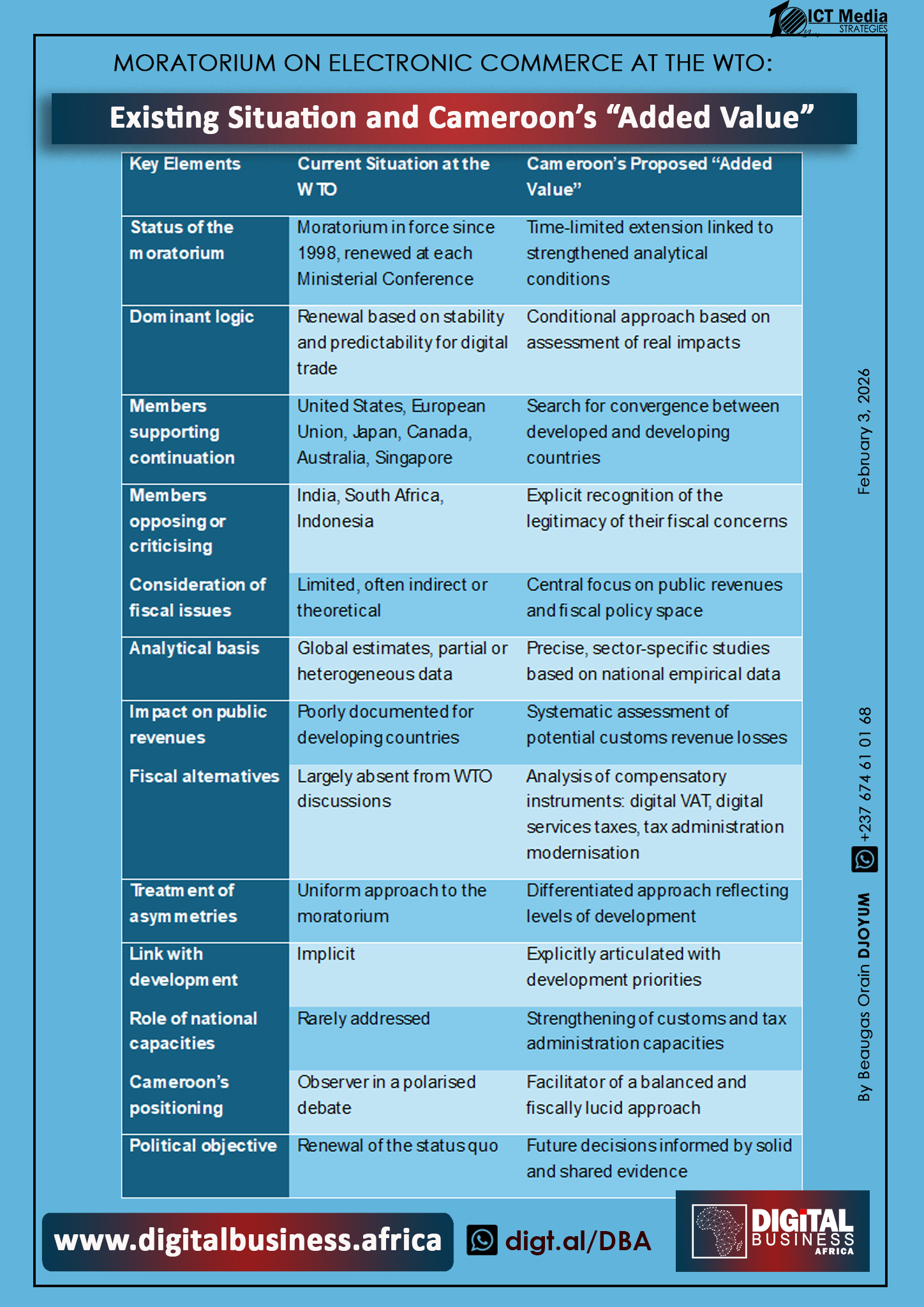
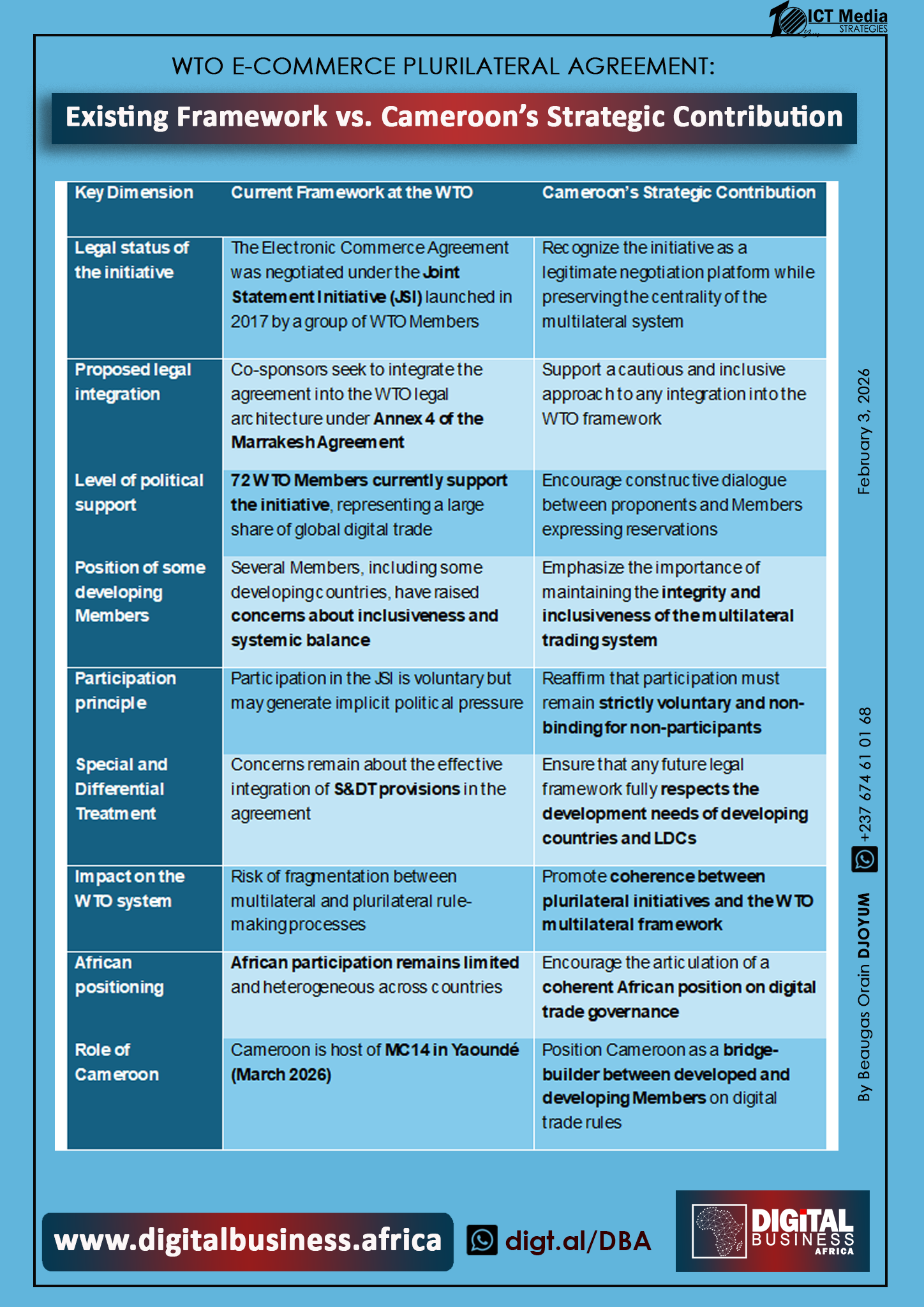
WTO E-Commerce Discussions: Existing Framework vs. Cameroon’s Added Value
KEY ELEMENTS
WHAT ALREADY EXISTS AT THE WTO
THE “ADDED VALUE” OF CAMEROON’S SUGGESTED PROPOSAL
Status of development within the Work Programme
Development recognised as a cross-cutting issue since 1998, without a dedicated structure
Creation of a clearly identified, structured development track
Nature of commitments
Broad political orientations, without precise operational mandates
Clarification of a functional framework to translate orientations into action
MC12 and MC13 decisions
Call to revitalise the Programme with a focus on development
Concrete deepening through a more readable internal organisation
ACP proposals
Strong emphasis on development, cooperation and revitalisation
Shift from declaratory logic to institutional structuring
Programme governance
Discussions dispersed across themes and sessions
Improved readability through a dedicated development pillar
Participation of developing countries and LDCs
Implicitly recognised through special and differential treatment
Explicit recognition of progressive participation in e-commerce
Flexibility and policy space
Present in the WTO system but weakly articulated for e-commerce
Clear integration of flexibility into digital discussions
Digital capacities
Technical assistance mentioned in general terms
Stronger link between e-commerce discussions, digital capacities and targeted support
Link with Annex 4 (LDCs)
Fragmented approach, without explicit articulation
Coherence between accession, development and e-commerce
Plurilateral digital agreements
Voluntary participation, but implicit political pressure
Reaffirmation of freedom of progressive, non-mandatory participation
Strategic vision
Issue-by-issue management
Structured vision of inclusive, development-oriented e-commerce
Political positioning
No clearly identified geographic leadership
Positioning Cameroon as a facilitator and North–South bridge as MC14 host
This proposal does not challenge the existing WTO framework on electronic commerce; it strengthens its coherence and effectiveness by translating broad political orientations into a structured, readable and development-oriented mechanism.
The second proposal: the moratorium and the centrality of digital taxation
Cameroon’s second proposal directly addresses the moratorium on electronic transmissions and places digital taxation at the centre of the debate. It could be framed as follows:
“MINISTERS AGREE TO EXTEND THE MORATORIUM ON CUSTOMS DUTIES APPLICABLE TO ELECTRONIC TRANSMISSIONS UNTIL THE NEXT MINISTERIAL CONFERENCE, WHILE SUBSTANTIALLY STRENGTHENING ANALYTICAL WORK ON ITS FISCAL, ECONOMIC AND DEVELOPMENT IMPACTS FOR DEVELOPING AND LEAST-DEVELOPED COUNTRIES, IN ORDER TO INFORM ANY FUTURE DECISION.”
This approach enables Cameroon to avoid a binary position. It recognises the usefulness of the moratorium for short-term stability in digital trade, while fully legitimising the fiscal concerns expressed by several countries of the Global South. Above all, it opens the way to precise, sector-specific, empirically grounded studies, allowing developing countries to realistically assess the effects of electronic commerce on their public revenues.
Digital taxation cannot remain a blind spot in WTO discussions. For many African countries, customs duties remain a critical source of public revenue. The progressive dematerialisation of trade therefore poses a major fiscal sustainability challenge. Without rigorous analysis of potential revenue losses—and of the capacity to compensate through other fiscal instruments—the moratorium debate will remain fragile and politically divisive.
Moratorium on e-commerce at the WTO: what exists and Cameroon’s “added value”
KEY ELEMENTS
CURRENT SITUATION AT THE WTO
THE “ADDED VALUE” CAMEROON COULD PROPOSE
Status of the moratorium
In place since 1998, renewed at each Ministerial Conference
Time-limited extension linked to strengthened analytical conditions
Dominant logic
Renewal based on digital trade stability
Conditional approach based on real-impact assessment
Countries supporting extension
United States, EU, Japan, Canada, Australia, Singapore
Search for convergence between developed and developing countries
Countries opposing/criticising
India, South Africa, Indonesia
Explicit recognition of the legitimacy of fiscal concerns
Consideration of taxation
Limited, often indirect or theoretical
Making public revenues and fiscal policy space central to the debate
Analytical base
Global estimates, partial or heterogeneous data
Precise, sectoral studies grounded in national empirical data
Impact on public revenues
Poorly documented for developing countries
Systematic assessment of potential customs revenue losses
Fiscal alternatives
Rarely integrated in WTO discussions
Analysis of compensatory tools: digital VAT, taxation of digital services, tax modernisation
Treatment of asymmetries
Uniform approach
Differentiated approach reflecting levels of development
Link to development
Implicit
Explicitly articulated with development priorities
Role of national capacities
Weakly addressed
Strengthening capacities of tax and customs administrations
Cameroon’s positioning
Observer in a polarised debate
Facilitator of a balanced and fiscally lucid approach
Political outcome
Status quo renewal
Future decisions informed by solid, shared evidence
Cameroon’s proposed approach does not challenge the moratorium on electronic commerce; it seeks to move the debate beyond an ideological standoff by placing digital taxation, public revenues and data-driven analysis at the centre of multilateral decision-making.
The case of the Plurilateral Agreement on Electronic Commerce: openness without haste
Finally, the WTO e-commerce debate cannot ignore the issue of the plurilateral Agreement on Electronic Commerce, whose request for incorporation into the WTO legal architecture under Annex 4 of the Marrakesh Agreement did not secure consensus at the General Council in December 2025. The request for Annex 4 incorporation, available since December 2024, was formally brought before the General Council in late 2025.
While 72 co-sponsors support this initiative and formally requested in December 2025 that the WTO incorporate it into Annex 4 of the WTO Agreements, several WTO Members—including India, South Africa and Indonesia, among other developing countries—expressed reservations, recalling the need to preserve inclusiveness and balance in the multilateral system. Among the 72 co-sponsors of this plurilateral agreement are six African countries: Benin, Burkina Faso, Cabo Verde, The Gambia, Kenya and Mauritius.
At the WTO, discussions on electronic commerce take place in two distinct but complementary tracks. On the one hand, the Work Programme on Electronic Commerce was established in 1998 to examine, in an exploratory manner, the relationship between existing WTO agreements and electronic commerce, without negotiating new formal rules.
On the other hand, a group of Members launched in 2017 the Joint Statement Initiative on Electronic Commerce (JSI), a plurilateral negotiating process open to all WTO Members, aimed at developing new and more binding rules on electronic commerce. Co-led by Australia, Japan, and Singapore, this initiative reflects a voluntary approach by Members who wish to move faster in digital disciplines.
After more than five years of negotiations under the JSI, a stabilised text of the Agreement on Electronic Commerce was published on 26 July 2024, marking a major milestone in the development of digital trade rules at the WTO.
According to the WTO, the Members participating in the JSI discussions represent more than 90% of world trade, although acceptance of the stabilised text is not yet unanimous among them.
What the plurilateral Agreement on Electronic Commerce provides in practice (Article 11)
The plurilateral Agreement on Electronic Commerce, resulting from the WTO’s JSI and finalised in July 2024, contains a specific provision on customs duties on electronic transmissions. Article 11 establishes three key principles:
Prohibition of customs duties on electronic transmissions (Article 11.3)
No Party shall impose customs duties on electronic transmissions between a person of one Party and a person of another Party.
This makes the moratorium principle legally binding among the Parties to the Agreement.
2. Scope for internal taxation (VAT, digital taxes, etc.) (Article 11.4)
For greater certainty, paragraph 3 does not preclude a Party from imposing internal taxes, fees, or other charges on electronic transmissions in a manner not inconsistent with the WTO AgreemenT.
The Agreement explicitly recognises internal fiscal sovereignty: VAT on digital services, platform taxes and other internal charges consistent with WTO rules are permitted, provided they do not amount to discriminatory treatment inconsistent with WTO agreements.
3. Periodic review clause (but no automatic reversal) (Article 11.5)
Taking into account the evolving nature of electronic commerce and digital technology, the Parties shall review this Article in the fifth year after the date of entry into force of this Agreement, and periodically thereafter, with a view to assessing the impacts of this Article and whether any amendments are appropriate.
There is a review clause after five years (supported by some developing countries during the negotiations). However, this clause is internal to the plurilateral Agreement, does not automatically allow suspension of the prohibition on customs duties, and does not condition the prohibition on fiscal studies or revenue impacts.
In this context, as a third proposal, Cameroon could adopt a prudent posture of openness. It may recognise the legitimacy of the plurilateral initiative, while emphasising that any legal incorporation must remain strictly voluntary, respect special and differential treatment, and create no direct or indirect pressure on developing and least-developed countries.
For Cameroon, the priority may remain the consolidation of the existing multilateral framework, notably through an effective and structured strengthening of the Work Programme on Electronic Commerce, before any legal advancement on plurilateral agreements.
Cameroon’s action
It is therefore crucial that Cameroon, through coordinated action by the Ministry of Trade, the Ministry of External Relations, Cameroon’s Permanent Mission to the WTO in Geneva, and the relevant technical administrations, take all necessary steps to bring these proposals to the next meeting of the WTO Work Programme on Electronic Commerce on 2 March 2026 in Geneva.
This is, more specifically, a multilateral working session preparing for the 14th WTO Ministerial Conference (MC14), which will take place from 26 to 29 March 2026 in Yaoundé, Cameroon.
This meeting follows directly from the exchanges on 28 January 2026, during which WTO Members examined prospects for reaching an outcome on electronic commerce at MC14, particularly on revitalising the Work Programme; the moratorium on customs duties on electronic transmissions; and potential elements for a ministerial decision in Yaoundé.
This is where Cameroon’s credibility will be tested—as a convergence actor and as host of a Ministerial Conference expected to deliver substantive outcomes.
With only a few weeks remaining before MC14 in Yaoundé, Cameroon has an important diplomatic window to contribute to a more mature, better informed and fairer debate on the future of electronic commerce.
By combining a development-centred reinvigoration of the Work Programme with a fiscally sound approach to the moratorium, Cameroon can help bring today’s antagonistic positions closer together and anchor multilateral digital trade on a truly inclusive trajectory.
Beyond MC14, this approach could also serve as the basis for a structured African contribution to the global debate on digital trade governance—reconciling openness, fairness and fiscal sustainability. The call for empirical analysis also aligns with ongoing discussions in other international fora on the taxation of the digital economy and could help Africa carry greater weight in shaping the rules of global digital trade.
By Beaugas-Orain DJOYUM
Publisher of Digital Business Africa and CEO of ICT Media STRATEGIES
[DIGITAL Business Africa] – Irish company AC Shining Stars Management Ltd (ACS) announced on January 21, 2026, from Dublin, that it has initiated international legal proceedings against South African telecommunications group MTN Group Limited and several of its subsidiaries, for the unauthorised use of the registered trademark “MOBILE MONEY®”.
According to the statement released by ACS, the proceedings target the alleged exploitation of this trademark in 14 countries: Benin, Botswana, Cameroon, Congo, Côte d’Ivoire, France, Ghana, Guinea-Bissau, Guinea (Conakry), Kenya, Liberia, Namibia, Rwanda, and Zambia.
The claimant company says it is seeking more than €4 billion in damages, equivalent to approximately CFA 2,600 billion, for what it describes as massive violations of its intellectual property rights.
A trademark registered in 37 jurisdictions
AC Shining Stars states that it is the holder of the “MOBILE MONEY®” trademark, registered with the World Intellectual Property Organization (WIPO) under number ROM.1318304. According to the company, the trademark is protected in 37 jurisdictions across three continents, including Europe, Africa, and Asia.
According to explanations provided by AC Shining Stars, whose legal counsel is ensured by Maître Paul Bayemi of Étoiles Avocats (Paris, France), the protection invoked is based both on direct national registrations in around twenty countries—including France, China, Ghana, Kenya, Morocco, Namibia, Rwanda, and Zambia—and on a regional registration via the African Intellectual Property Organization, covering 17 African States, including Cameroon, Côte d’Ivoire, Senegal, Mali, and Chad.
ACS further states that these registrations were examined and validated by more than twenty national and regional intellectual property offices.
Legal action following unsuccessful non-contentious efforts
Still, according to the statement, the legal action follows several years of unsuccessful attempts at amicable settlement. AC Shining Stars claims to have undertaken non-contentious initiatives, including what it describes as diplomatic approaches, which did not succeed.
The company says it decided to refer the matter to the competent courts after concluding that its efforts had been ignored by MTN Group and that the situation could no longer be resolved outside judicial proceedings.
A contested commercial exploitation
In its communication, AC Shining Stars accuses MTN Group and its subsidiaries of having commercially exploited the “MOBILE MONEY®” trademark in several protected markets without authorisation, to the detriment of partners holding, according to the company, legitimate licenses.
The company considers that such uses constitute trademark infringement and justify the damages claim filed in the ongoing proceedings.
A warning to market players
Through this legal action and its public communication, AC Shining Stars says it seeks to reaffirm that the “MOBILE MONEY®” trademark is a protected intellectual property and that no organisation or individual is authorised to use it without prior written consent.
The company adds that any unauthorised use, including use as a generic term, may constitute a trademark violation and be subject to legal action.
At this stage, MTN Group has not yet publicly commented on the matter.
“MOBILE MONEY” trademark: what WIPO’s official registers show
The available data confirm the existence of an active international registration and reveal significant nuances in the actual scope of protection across countries and service classes.
A trademark registered since 2016 and still active
The “MOBILE MONEY” word mark has been registered since July 21, 2016, in the name of AC Shining Stars Management Ltd, based in Cork, Ireland. The international registration is listed as active, with an expiry date of July 21, 2026.
The filing language is French, and the trademark is represented in standard characters.
Three key classes for FinTech and telecommunications
The international registration covers three classes under the Nice Classification, which are particularly sensitive to the digital ecosystem:
– Class 9, relating to electronic equipment, software, digital devices, and technological hardware;
– Class 36, covering financial, banking, payment, insurance, and financial management services;
– Class 38, dedicated to telecommunications, mobile communications, and network access services.
These classes correspond directly to the core activities of mobile money services and modern telecom offerings.
Territorial protection varies by country
As provided for under the Madrid system, protection of an international trademark is not uniform and depends on decisions taken by each national office.
WIPO registers show that the trademark enjoys full protection in certain States, such as Morocco, where Classes 9, 36, and 38 were expressly accepted by the competent national office.
Conversely, in other countries, protection is partial. In Madagascar, for example, WIPO data indicate that only Class 9 is protected, while financial and telecommunications services under Classes 36 and 38 were subject to a partial provisional refusal notified in 2017.
A change of ownership was recorded in 2024
Another element appears in the official history of the trademark: a change of holder was recorded on August 23, 2024.
At this stage, the information available in WIPO’s international register does not specify the nature of this change (assignment, restructuring, transfer, or otherwise), nor the identity of the previous holder.
In the absence of these public details, it is not possible, based solely on the register, to determine the exact terms of the transfer or to draw conclusions regarding prior ownership of the trademark.
Key takeaways
The verifications carried out by Digital Business Africa, therefore, confirm the existence of a valid international registration of the “MOBILE MONEY” trademark, in force until July 2026. They also show that the scope of this protection varies across territories and service classes, a central element in any analysis or proceedings relating to the use of this trademark.
About AC Shining Stars Management Ltd
AC Shining Stars Management Ltd is an Irish limited liability company registered with the Companies Registration Office (CRO), the official register of companies in Ireland. According to information available in the professional database SoloCheck, the company was incorporated on Friday, September 3, 2021, and currently has a normal (active) status.
Still, according to SoloCheck, AC Shining Stars Management Ltd is registered under company number 703071. Its declared address is partial and located in Dublin 2, an area that hosts a large number of companies; the company shares its Eircode with more than 1,600 other registered entities.
The company is classified as a micro-enterprise, with a declared principal activity under code [6202] – Computer consultancy activities. It may trade under the name AC Shining Stars Management Ltd.
Governance and positioning
Cédric Atangana
Contacted by Digital Business Africa, Cameroonian national Cédric Atangana states that he is the Chairman of the Board of AC Shining Stars Management Ltd. He further says that the company relies on “an expanded board of directors made up of international experts spread across all five continents”.
A company claiming an international footprint
On its website, AC Shining Stars Management Ltd presents itself as an independent international financial technology services company, founded on a values-driven culture and a long-term value creation approach.
Based in Dublin, at the heart of one of Europe’s leading financial hubs, the company says it relies on multidisciplinary expertise, structured intellectual capital, and a global network to support its clients and partners.
It claims an operational presence in more than 85 countries across Europe, North America, Asia, and Africa.
Declared areas of expertise
According to its institutional communications, AC Shining Stars Management operates notably in:
– intellectual property and investments in intangible assets;
– financial advisory and financial technology services;
– digital payments and international remittances;
– data analytics, business intelligence, and decision support;
– venture capital and private equity investments.
A model structured around five business pillars
The company states that it bases its long-term development on a model structured around five interconnected activities:
– intellectual property investments and private equity;
– digital payments and remittance services;
– financial inclusion;
– data analytics, insights, and business intelligence;
– international purchasing centre.
An intellectual property–focused strategy
AC Shining Stars Management says it invests in the acquisition, protection, exploitation, and licensing of intellectual property rights, including trademarks, patents, inventions, trade secrets, copyrights, and artistic assets.
The company also indicates that it is involved in the financing of intellectual property litigation, particularly when assets it owns or operates in partnership are, in its view, subject to abusive use.
In this context, as AC Shining Stars Management claims to base part of its business model on investing in the acquisition, protection, exploitation, and licensing of intellectual property rights, the legal proceedings initiated against MTN Group are expected to be closely followed.
They should make it possible to assess, before the competent courts, the concrete scope of this investment strategy in intangible assets, as well as its potential implications for the mobile money and FinTech ecosystem at the African and international levels.
[DIGITAL Business Africa] – As Cameroon accelerates its digital transformation, cybercrime is emerging as one of the country’s main security challenges. Online scams, identity theft, intrusions into information systems, attacks on institutional reputations and the exploitation of technical vulnerabilities: threats are multiplying. Figures recently released by the Director General of the National Agency for Information and Communication Technologies (ANTIC), Prof. Ebot Ebot Enaw, paint an unvarnished picture of the situation.
A surge in digital investigation requisitions
In 2025, ANTIC processed 32,500 judicial requisitions, a 30% increase on 2024. These requisitions, received daily by the agency, relate to investigations into offences committed using digital tools. On average, nearly 200 requisitions are recorded each day, some involving multiple suspects, reflecting growing operational pressure on digital investigation teams.
Thousands of vulnerabilities detected in systems
Since January 2024, vulnerability scans and security audits conducted by ANTIC in public administrations and private companies have identified 8,502 vulnerabilities. These technical flaws, often exploited by cybercriminals, expose systems to intrusions, data leaks and digital sabotage. Each detection is followed by corrective measures to strengthen the security mechanisms of the affected entities.
Fake accounts and identity theft on social networks
Cybercrime is no longer limited to technical attacks. It has now spread to social networks, which have become a preferred ground for identity theft and information manipulation. Since January 2024, ANTIC has identified 8,499 fake accounts impersonating senior State officials or public institutions. Thanks to cooperation with platforms such as Facebook and TikTok, 6,416 of these accounts have been shut down, reducing the risks of fraud, disinformation and damage to institutional credibility.
Digital evidence at the heart of judicial proceedings
Within judicial investigations, ANTIC also plays a key role in the authentication of digital evidence. At the request of judicial authorities, 206 reports authenticating digital evidence were produced, confirming the central role of electronic data in contemporary criminal procedures.
Ever-growing volumes of data to process
Digital investigations generate vast volumes of data. According to ANTIC, around 200 gigabytes of data are processed daily for investigative purposes, amounting to nearly 73 terabytes per year. This volume grows by about 10% annually, imposing high requirements for storage, processing and analysis to respond effectively to requests within tight deadlines.
The e-Gov’A Summit
This reality also underscores the urgent need for structured dialogue among public authorities, digital experts and private-sector actors on issues of cybersecurity, identity theft and digital governance. This is precisely the rationale for the e-Gov’A Forum, scheduled for May 14–16, 2026, under the theme: “Artificial intelligence and e-governance: building efficient public services in a cashless and paperless Africa”.
This continental event aims to raise awareness among public decision-makers of the need for an official, well-managed institutional presence on the web, a key condition for combating the proliferation of fake accounts, disinformation and cyber threats. It also seeks to promote a culture of cybersecurity grounded in technology, governance and user awareness.
A major strengthening of capacities through PATNUC
Faced with the growing scale of attacks and requests, Cameroon has committed to substantially strengthening its operational cybersecurity capacities. In this context, the equipment acquisition project for the Cybersecurity Incident Response Center (CIRT), financed by the Digital Transformation Acceleration Project (PATNUC), has enabled ANTIC to be equipped with a cutting-edge technological system comprising five high-performance servers, three digital investigation platforms, twenty storage consoles, thirty specialised workstations, and three vulnerability scanning and penetration testing platforms. These tools are intended to enhance monitoring, analysis, and response to cyber incidents at the national level.
The call from ICT Media STRATEGIES
For Beaugas Orain Djoyum, Managing Director of ICT Media STRATEGIES, “these figures clearly show that cybercrime is no longer an abstract threat, but a daily reality in Cameroon. The explosion of fake accounts and identity theft requires public decision-makers, institutional leaders and business executives to occupy the digital space themselves in an official, professional and proactive manner. Absence online leaves the field open to impostors.” He adds: “Beyond repression, awareness-raising among citizens, administrations and economic actors remains essential. Being present on digital platforms is key. A safer cyberspace also depends on better digital culture and collective vigilance.”
Towards a safer and more resilient cyberspace
While these investments represent major progress, the Director General of ANTIC stresses that technology alone is not enough. Strengthening human skills remains a crucial lever. Complementary training projects for ANTIC staff and public administration agents have therefore been submitted to PATNUC, with the ambition of building a safer, more resilient and more attractive Cameroonian cyberspace for citizens, businesses, startups and investors.
[Digital Business Africa] – Present in Africa for more than 20 years, Kaspersky now relies on local technical and commercial teams that support SMEs and their African partners daily, in a context where threats and solutions are constantly evolving.
This is what Pascal Naudin, Head of B2B – Morocco, Tunisia, West & Central Africa at Kaspersky, explains in this interview with Digital Business Africa. He also outlines the main obstacles preventing African SMEs from implementing adequate protection and presents Kaspersky’s appropriate solutions.
Digital Business Africa: Why do cybersecurity strategies in African SMEs often remain theoretical rather than operational?
Pascal Naudin: Many SMEs, in Africa as elsewhere, assume that their size naturally protects them from cyberattacks. This perception leads them to treat cybersecurity as a secondary issue, often limited to basic measures such as protecting workstations and servers.
Cyber threats are still too often associated solely with viruses. In this context, SMEs turn to consumer‑grade solutions designed for individual use. While these tools may be sufficient for isolated devices, they become inadequate once systems are interconnected within a corporate network. At that point, the attack surface increases significantly and requires a much more structured approach.
Digital Business Africa: What are the main obstacles preventing SMEs from implementing adequate protection?
Pascal Naudin: An SME’s priority remains its operational activity: producing, selling, invoicing, managing inventory, logistics, or customer relations. Immediate economic considerations, therefore, guide decisions, and cybersecurity is often perceived as a cost with no visible short‑term return on investment.
Yet cybersecurity is inherently constantly evolving. Solutions must be regularly updated, monitored, and adjusted. Many SMEs lack both the financial resources and the internal expertise to hire a full‑time IT specialist, which significantly slows the transition to truly operational protection.
Digital Business Africa: What operational weaknesses do you most often observe in African SMEs?
Pascal Naudin: It is primarily an underestimation of risk rather than a lack of professionalism. Most SMEs are not fully aware of the intensity of cyber threats or their potential consequences. Physical security of premises or protection of paper documents is well understood, but digital risk remains abstract until an incident occurs.
In this context, cybersecurity investments are still seen as constraints rather than strategic priorities. This situation is exacerbated by a local shortage of cybersecurity skills, making securing information systems particularly complex without external support.
Digital Business Africa: Can you share real‑world situations that illustrate these vulnerabilities?
Pascal Naudin: There are many cases. Some SMEs, for example, continue to use security solutions with expired licenses, leaving them without adequate protection—sometimes without even realizing it.
In other situations, consumer‑grade security solutions are installed individually on each workstation, with no coordination or overall visibility. These tools may be suitable for personal use, but they are ineffective against threats that can silently spread across an entire professional IT environment.
Digital Business Africa: How can SMEs move from theoretical cybersecurity to absolute, adequate protection?
Pascal Naudin: The first step is recognizing that digitalization is no longer a project but a reality. Invoices, emails, appointments, and professional exchanges now rely heavily on digital channels. In this context, any device—computer or smartphone—can serve as an entry point for an attack.
There are now solutions tailored to each company’s size and maturity, capable of operating in an interconnected manner. But one of the simplest and most effective levers remains user awareness. Since users are the primary targets of phishing attacks, regular awareness campaigns significantly reduce the attack surface and incident risk.
Digital Business Africa: How does the transition from EDR to XDR represent progress for SMEs?
Pascal Naudin: A few years ago, an antivirus was enough to create a sense of security. Today, attacks are more sophisticated, stealthier, and harder to detect. EDR solutions already represent a significant step forward in addressing next‑generation threats.
XDR goes further by expanding the analysis perimeter beyond workstations to include network traffic and cloud environments. Thanks to AI‑based technologies, Kaspersky’s XDR solution provides a comprehensive view of multi‑vector attacks and enables much more coherent detection and response.
Digital Business Africa: What role does employee awareness play in reducing cyber risks?
Pascal Naudin: The user must become the company’s first line of defense. A structured awareness program can reduce attack propagation by up to 80%. Cybersecurity, therefore, does not rely solely on technological tools but on a shared culture supported by top management.
In practice, training modules teach employees to recognize phishing emails and social engineering attempts. A single click can be enough to trigger major attacks, such as ransomware or data theft, without the user’s knowledge.
Digital Business Africa: Why is support from technology partners like Kaspersky essential for African SMEs?
Pascal Naudin: Faced with increasingly sophisticated cyber threats, isolation is no longer an option. Cybersecurity relies on the sharing of expertise and cooperation among stakeholders.
Kaspersky’s partner network plays a key role in this approach. Regularly trained, these partners ensure deployments adhere to best practices. Present in Africa for more than twenty years, Kaspersky now relies on local technical and commercial teams who support SMEs and their partners daily, in a context where threats and solutions are constantly evolving.
[Digital Business Africa] – Cameroon is moving forward with its plan to modernize its public administration. Thanks to a 4.6‑billion‑F.CFA funding package provided by the Republic of Korea, three training centers dedicated to the digital transformation of civil servants will be created within ENAM, SUP’PTIC and ISMP. This structuring initiative aims to equip Cameroon’s public administration with the skills needed to deliver faster, more efficient and fully digital public services.
Three centers to train civil servants for the digital era
Unveiled on December 16, 2025, in Yaoundé, these training centers form the core of the e‑government capacity‑building program implemented with the Korean agency KOICA. Their mission is to transform traditional public‑sector skills into harmonized digital competencies.
– ENAM: training administrators and magistrates in digital governance
– SUP’PTIC: developing technical skills in information systems
– ISMP: strengthening digital public‑management capabilities
These infrastructures will professionalize the State’s digital transformation by creating a true pipeline of public‑sector digital expertise.
An e‑Gov Exhibition Center to showcase public‑sector innovation
In addition to the three training centers, the project also includes the creation of an e‑Government Exhibition Center.
This facility will serve as a technological showcase for platforms, solutions and digital innovations developed by the Cameroonian administration. It will play a key role in spreading digital culture across public institutions.
A project to be presented at the E‑Gov’A Summit in May 2026
This ambitious program will be officially presented at the E‑Gov’A Summit, the major African event on e‑governance and digital innovation, organized by Smart Click Africa and Digital Business Africa from May 14 to 16, 2026.
It will be an opportunity to unveil architectural models, training objectives, planned technologies and the expected impact on the modernization of the State.
South Korea, through KOICA, will present this project as a model of successful international cooperation and a major lever for accelerating the digital transformation of the public sector.
A strategic cooperation aligned with the SND30
According to the Minister of the Economy, Alamine Ousmane Mey, these infrastructures align with the vision of a “modern, efficient, productive” administration, essential for the country’s emergence.
Korean Ambassador Nam Ki‑Wook emphasized that these projects will “modernize administrative systems, making them more efficient and competent,” thereby strengthening Cameroon’s long‑term sustainable growth.
[DIGITAL Business Africa] – Cameroon’s Ministry of External Relations (MINREX) issued an official statement on 17 December 2025 reporting malfunctions identified during certain transactions carried out on the Cameroon e-Visa platform, Evisacam. According to MINREX, some users may have experienced unauthorized debits from their bank accounts when paying visa fees online.
According to the statement, these situations were identified through enhanced monitoring of transactions processed on the Evisacam platform. Without specifying the exact scale of the issue, the Ministry acknowledges that anomalies may have affected the bank accounts of some users who made payments through the electronic channels integrated into the e-Visa system.
To ensure swift and effective handling of complaints, MINREX invites affected users to complete the dedicated online form at https://claim.evisacam.cm. This complaints platform is designed to centralise claims and facilitate their processing by the relevant teams, in collaboration with the banking partners involved in payment operations.
The Ministry of External Relations states that each complaint submitted through this channel will be processed immediately to restore the situation for affected users and correct any anomalies identified in their accounts.
In its statement, MINREX apologises for any inconvenience caused and thanks users for their trust. It also reaffirms its commitment to enhancing the reliability and security of digital services for visa issuance in Cameroon.
Implemented as part of the modernisation of consular services, the Cameroon e-Visa is one of the pillars of MINREX’s digitalisation strategy, aimed at simplifying administrative procedures for travellers and enhancing the country’s attractiveness.
To implement this innovation, the State of Cameroon entered into a partnership with Impact Palmares Group, which was recently consolidated. Through this communication, the Ministry seeks to reassure users of the administration’s ability to detect and swiftly resolve incidents that may arise within the framework of digital public services.
[Digital Business Africa] – Cameroon is accelerating its transition toward an assertive digital sovereignty. On the occasion of the “Cloud Days” organized by Cameroon Telecommunications (CAMTEL) at the Zamengoe Data Center, public authorities and digital sector stakeholders laid the foundations for a strategic repositioning: better regulation of data exploitation, reduced dependence on foreign cloud providers, and the structuring of a local ecosystem aligned with new regulatory requirements.
Data: A New Lever for Competitiveness and Sovereignty
In a context marked by the widespread adoption of cloud computing, artificial intelligence, and digital services, data has become a strategic asset. It determines business performance, state security, and the innovative capacity of economies.
However, as in many African countries, a significant share of Cameroonian data is still hosted outside the continent. This situation exposes local organizations to legal and strategic risks, particularly in the face of extraterritorial legislation such as the U.S. Cloud Act.
For CAMTEL, the objective is now clear: to regain legal, technical, and economic control over national data.
A New Law to Structure the Market
Law No. 2024/017 of 23 December 2024 on the protection of personal data forms the cornerstone of this strategy. It significantly modernizes Cameroon’s regulatory framework and brings the country closer to international standards, notably the European GDPR.
The law imposes strengthened obligations on companies, public administrations, and digital platforms: lawful grounds for data processing, transparency toward users, information system security, and internal data governance. The sanctions provided for—up to one billion CFA francs—reflect the authorities’ determination to ensure effective compliance.
Cloud, Data Localization, and New Trade-offs
One of the most sensitive issues concerns international data transfers. Cameroonian regulations now strictly govern cross-border data flows and encourage local hosting, particularly for sensitive data related to health, public finances, biometrics, and telecommunications.
For companies using international cloud solutions, these requirements imply new trade-offs: partial data relocation, contract renegotiation, reliance on local data centers, or the adoption of so-called “sovereign cloud” offerings.
In the long term, this movement could stimulate investment in national digital infrastructure.
Cybersecurity: A Catalyst for Reform
The strengthening of regulation comes amid several major cyber incidents in Cameroon. Ransomware attacks, leaks of sensitive data, and service outages have highlighted the vulnerabilities of many organizations.
The law now introduces a mandatory data breach notification requirement, increasing pressure on companies to invest in cybersecurity, staff training, and digital risk management.
A Highly Anticipated Regulatory Authority
The creation of an independent National Data Protection Authority is a central pillar of the framework. Responsible for authorizing, monitoring, and sanctioning, it will play a key role in the effective enforcement of the law and the credibility of the regulatory environment.
For market participants, the authority’s resources, independence, and operational capacity will be critical to avoiding legal uncertainty.
Compliance: Constraint or Business Opportunity?
While compliance represents a short-term cost, it is also viewed as an opportunity to structure the market. The development of local data centers, compliance services, managed cybersecurity, and sovereign cloud solutions are all segments likely to benefit from the new regulatory landscape.
For both authorities and operators, the challenge lies in transforming regulatory constraints into a driver of digital competitiveness.
A Strategic Shift to Be Confirmed
With this reform, Cameroon is demonstrating strong political will to make data a pillar of its digital and economic strategy. The legal framework is in place, infrastructure is beginning to follow, but success will depend on execution, public–private coordination, and the market’s ability to adapt.
For Cameroon, data sovereignty is no longer a theoretical concept. It is becoming a structuring project for the national digital business ecosystem.
[DIGITAL Business Africa] – By entering into a strategic cooperation with Ethio Telecom, CAMTEL is choosing to rely on one of Africa’s leading telecom innovators to accelerate Cameroon’s digital transformation. At the heart of this alliance lies a key priority: the expansion and scaling-up of Blue Money, CAMTEL’s electronic payment service, now positioned to become a central driver of the country’s digital economy.
On December 4, 2025, in Yaoundé, CAMTEL and Ethio Telecom signed a three-year Master Service Agreement (MSA). The ceremony, presided over by Judith Yah Sunday Epse Achidi, General Manager of CAMTEL, and Frehiwot Tamiru, CEO of Ethio Telecom, marked the launch of an unprecedented South–South partnership between two state-owned operators determined to accelerate Africa’s digital momentum.
Astrategic partnership to advance Cameroon’s digital development
With more than 86 million subscribers, 16,000 employees, and a turnover of approximately 731 billion CFA francs, Ethio Telecom ranks among the continent’s most robust and structured telecom operators. Its remarkable transformation over the past six years—driven by significant infrastructure investments, extensive service digitalisation and rapid progress in financial inclusion—is now a source of inspiration for CAMTEL.
For Judith Yah Sunday, the objective is clear: to leverage a successful African model to accelerate CAMTEL’s internal restructuring, modernize its networks, digitalize its services, and, above all, scale up Blue Money. “Ethio Telecom is a model for us. They have transformed their country digitally. Their expertise will be essential to strengthening Blue Money and enhancing our ability to offer innovative financial services to Cameroonians,” she emphasised.
Blue Money at the centre of the CAMTEL–Ethio Telecom cooperation
Among the four priority pillars of the partnership, the expansion of Blue Money stands out as a strategic focus. CAMTEL intends to capitalise on Ethio Telecom’s expertise—particularly that gained through Telebirr, the most successful mobile money platform in the region with more than 40 million users.
This transfer of know-how will be crucial in several areas:
– upgrading Blue Money’s technical architecture
– strengthening the platform’s security and regulatory compliance
– expanding its distribution network
– developing new digital financial services tailored to local needs
– scaling the service through a more ambitious and structured commercial strategy
For CAMTEL, Blue Money is no longer a complementary product; it is a central major pillar of the company’s digital transformation and a key instrument to position the operator as a vital player in Cameroon’s mobile money landscape.
From public service digitalisation to network modernisation
Beyond Blue Money, the agreement also includes:
– support for deploying a sovereign Government Cloud
– modernisation of telecom networks, including 4G, 5G, and innovative technologies
– enhancement of customer experience
– training programmes, mentoring, and extensive knowledge transfer between Ethiopian and Cameroonian teams.
For Frehiwot Tamiru, CEO of Ethio Telecom, this partnership marks a significant step forward in intra-African cooperation. “CAMTEL is engaging in a complete transformation. We are privileged to stand by their side to share our proven experience, particularly in digital and financial solutions,” she stated.
An accelerator for Cameroon’s digital autonomy
By integrating the expertise of a continental leader, CAMTEL aims to enhance its competitiveness, improve service quality, and offer digital solutions that meet the expectations of both citizens and businesses.
This partnership could also help Blue Money emerge as a stronger and more attractive contender in Cameroon’s mobile money market—currently dominated by MTN Mobile Money and Orange Money—while supporting broader national initiatives in digital public service delivery.
The CAMTEL–Ethio Telecom cooperation underscores a growing reality in Africa’s digital landscape: the continent already possesses strong home-grown success models, and the future of its digital transformation will increasingly be built through South–South partnerships rooted in shared expertise and innovation.
If this collaboration delivers on its promises, Blue Money may soon become one of the most visible symbols of the new era of interconnectivity and modernisation that CAMTEL aims to drive.