
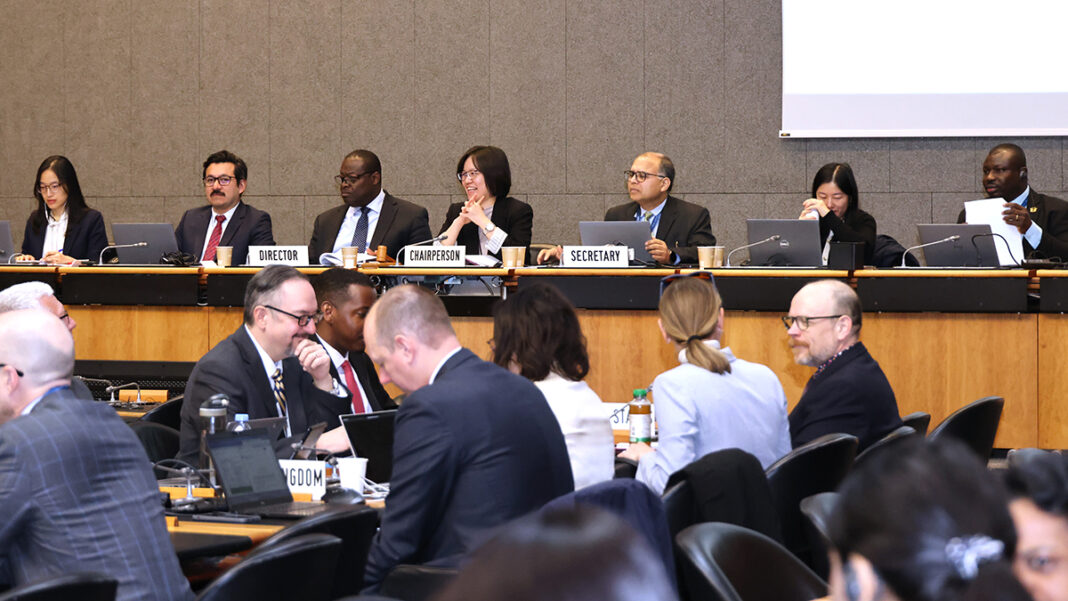

[Digital Business Africa] – Just days before the 14th WTO Ministerial Conference (MC14), scheduled to be held in Yaoundé from 26 to 29 March 2026, a group of fifteen countries – including Australia, Canada, Japan, Singapore, Switzerland, the United Kingdom, and Uruguay – is proposing a major evolution in the global governance of digital trade.
Their communication, dated 17 March 2026, calls for the establishment of a WTO Committee on Digital Trade to replace and formalise the Work Programme on Electronic Commerce (WPEC), launched in 1998.
A context marked by digital urgency
For nearly thirty years, the WPEC has studied trade-related issues connected to e-commerce. However, according to the authors of the communication, the programme has been hampered by “procedural issues” that have consumed a significant portion of members’ resources. Meanwhile, digital technologies – especially artificial intelligence – have deeply transformed global trade.
The signatories note that the current WPEC mandate expires either at MC14 or on March 31, 2026, and that the moratorium on customs duties on electronic transmissions also expires on that date. They therefore believe it is necessary to progress to the next stage.
Committee on Digital Trade: an updated framework
The proposal is clear: “We identify the need for a formal WTO committee with an updated, forward-looking mandate” to address the complex issues of global digital trade.
The future Committee would have several key missions:
- Institutionalize the WPEC and modernize its mandate
It would become a permanent multilateral forum for dialogue on digital policies, including AI and emerging technologies. The document highlights that it would serve as a space “for dialogue, collaboration, and transparency.” - Strengthen international coordination
The Committee would collaborate with other WTO bodies, international organizations, and external stakeholders to better address digital opportunities and challenges. - Reduce the digital divide
A key component concerns developing countries and least-developed countries (LDCs). The text emphasizes the need to “identify gaps in support aimed at reducing the digital divide.” Developed members – and capable developing countries – are encouraged to support others. - Create a joint database on capacity building
The document proposes establishing an international database listing training and capacity-building programmes related to digital trade, particularly for SMEs. - Define terms of reference by 2027
The Committee would be required to submit its terms of reference to the General Council at its first meeting in 2027.
A strong signal for WTO reform
For the signatories, the creation of this Committee would be a “signal of the continued relevance of the WTO” in a world where digital trade is becoming central. It would also represent a concrete outcome for MC14, strengthening the organisation’s deliberative function. A draft ministerial decision has already been submitted in this regard and will be discussed in Yaoundé.
What impact on Africa?
Holding MC14 in Yaoundé gives this proposal particular resonance for the continent. Africa, still marked by significant digital access inequalities, could benefit from:
- a more structured multilateral framework to defend its priorities;
- improved access to capacity-building programmes;
- greater visibility for its digital SMEs;
- a platform to influence emerging rules on AI, data, and digital platforms.
For African countries, the stakes are strategic: to actively shape the rules of global digital trade rather than passively adapt to them.
A pivotal moment
The proposal to establish a Committee on Digital Trade marks a decisive step in the evolution of global trade governance. At a time when AI, data, and platforms are transforming value chains, the WTO is aiming to reinvent itself.
MC14 could therefore become a historic moment, not only for the organisation but also for African countries hosting a WTO Ministerial Conference for the first time.
Digital Business Africa, which you will find at the Palais des Congrès during MC14, will closely follow the negotiations and the reactions of African delegations in the coming days.
By Digital Business Africa
Read also: