
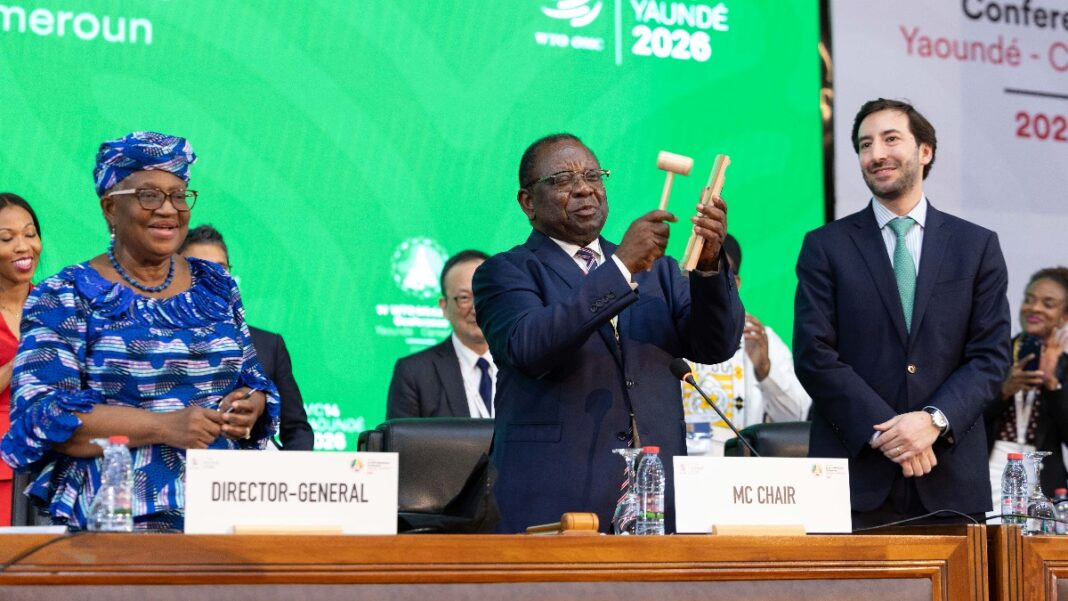

[Digital Business Africa] – The high-level discussions of the World Trade Organisation (WTO), held in Yaoundé, concluded this Monday at 2 a.m. with no major breakthroughs after two lengthy ministerial sessions. The 14th Ministerial Conference (MC14) was characterised by the inability of the 166 members to extend the moratorium that, since 1998, had exempted cross-border electronic transmissions from customs duties. Participants agreed to continue discussions in Geneva on a precise but undisclosed timeline.
This moratorium, a key element of global e-commerce, expires tomorrow, 31 March 2026, following the decision taken at MC13. With no agreement in Yaoundé on its extension, a unique situation arises. While this does not mean tariffs will be imposed immediately, the failure represents a significant setback for developed countries and the United States in particular, which pushed for its permanent renewal and threatened to leave the WTO or declare its demise if it was not renewed.
Before MC14 began, U.S. Ambassador Joseph Barloon stated that maintaining the moratorium would give the United States the necessary confidence to “remain fully engaged” in the WTO. Another American diplomat, cited by Reuters, warned: “If Jamieson Greer (the 20th United States Trade Representative) leaves Yaoundé without a moratorium, U.S. proclamations about the death of the WTO will be even stronger.”
By advocating for a permanent extension of the moratorium, the United States continues to safeguard its digital dominance. This enables its companies to offer services without tariff barriers, thereby undermining the fiscal capacities of developing nations. Donald Trump, consistent with his protectionist and transactional stance, views any weakening of the moratorium as an assault on American economic interests. Consequently, he has threatened to withdraw or declare the “death of the WTO” if it is not extended.
Response from the WTO Director-General
Asked by Digital Business Africa about the interpretation of these threats, given that the moratorium was not extended, Director-General Ngozi Okonjo-Iweala downplayed the situation.
“Members often take firm positions before a ministerial. That’s the art of negotiation, isn’t it? Sometimes, everyone holds their ground, and the goal is to find common ground. Sometimes we succeed, sometimes we don’t. In this case, we had nearly reached a compromise. Members had identified a new landing zone, different from what we used before, not an automatic extension. There are still a few members to persuade, including the United States, which was present and expressed a willingness to continue negotiations.”
Implications for Developing Countries
With no agreement in Yaoundé, developing countries can now demand and collect customs duties on electronic transmissions. This could boost the finances of these states that are constantly seeking to expand their tax base.
Since 1998, the moratorium has prohibited WTO members from imposing customs duties on cross-border digital flows. Its expiry opens the door to discussions on international digital taxation, particularly for African countries seeking fiscal sovereignty.
Historical Context: Seattle 1999 and Doha 2001
Ngozi Okonjo-Iweala points out that this is not the first time the moratorium has expired. In 1999, during the Seattle Ministerial Conference, members failed to agree on its extension. The moratorium had therefore temporarily expired before being reinstated two years later, in Doha, in 2001. This sequence demonstrates that the failure to extend does not automatically result in the imposition of customs duties but rather creates a zone of uncertainty.
If Customs Duties Were Applied…
If customs duties were to be imposed in some developing countries, they would concern solely cross-border electronic transmissions – i.e., digital data flows crossing borders via the Internet.
Taxation could take two forms: either through telecom operators (ISPs), who would be responsible for measuring and billing the volume of imported data, or through major digital platforms (Netflix, Microsoft, Google, AWS, etc., see illustration below), which would need to declare the value of the content transmitted and pass the cost on to end users.
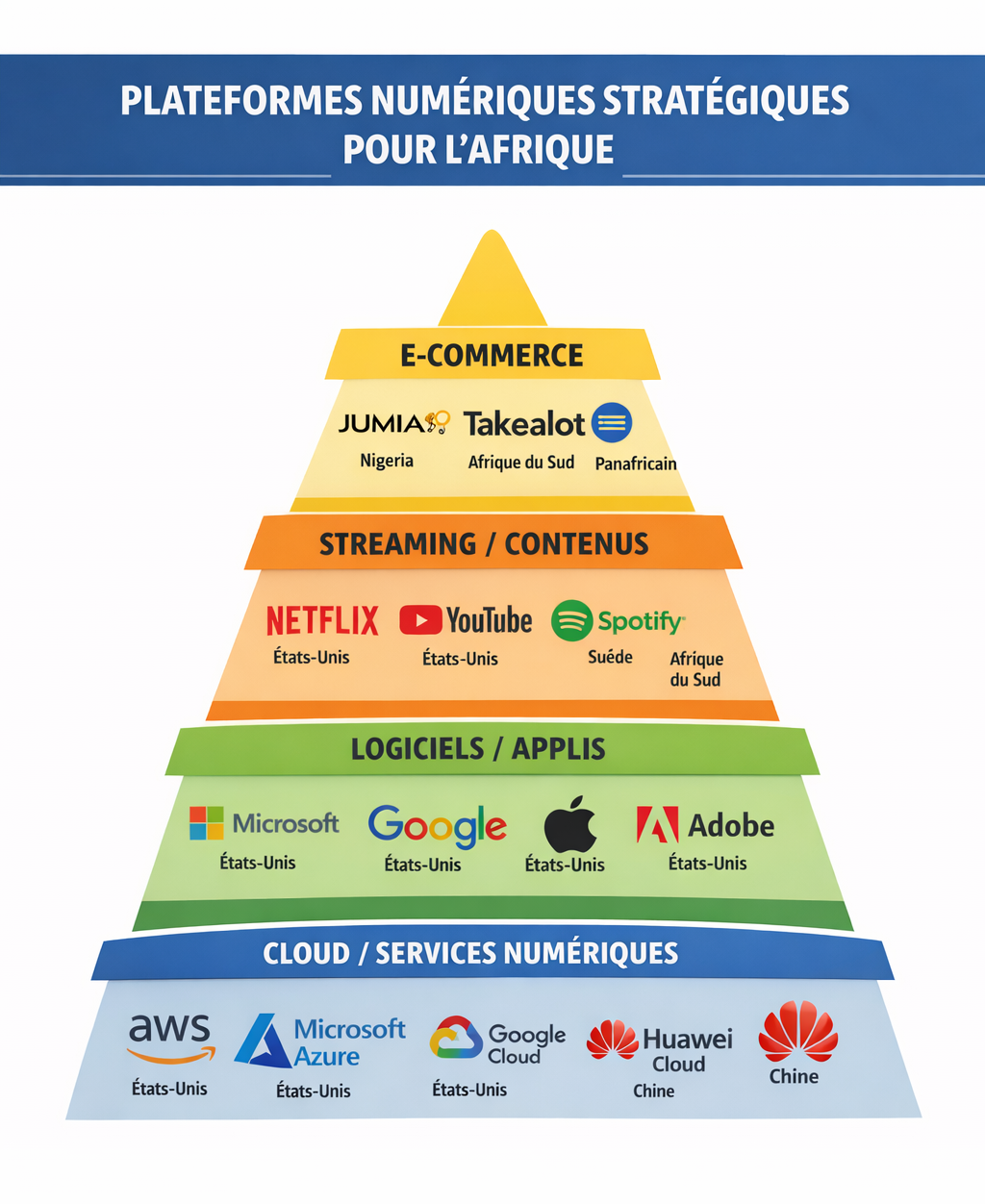 Digital platforms are likely to collect customs duties if the moratorium on electronic transmissions is not extended.
In both cases, the goal would be to target the electronic transmission channel itself rather than the digital content.
However, the technical and political challenges would be significant: differentiating cross-border flows from domestic ones, maintaining traceability without compromising Net Neutrality, preventing excessive cost hikes for consumers and local SMEs, while managing diplomatic tensions with the United States.
In other words, taxing electronic transmissions would not be just a financial measure but a strategic decision that impacts digital sovereignty and the balance of international trade relations.
The Brazil-India Barrier vs. The United States
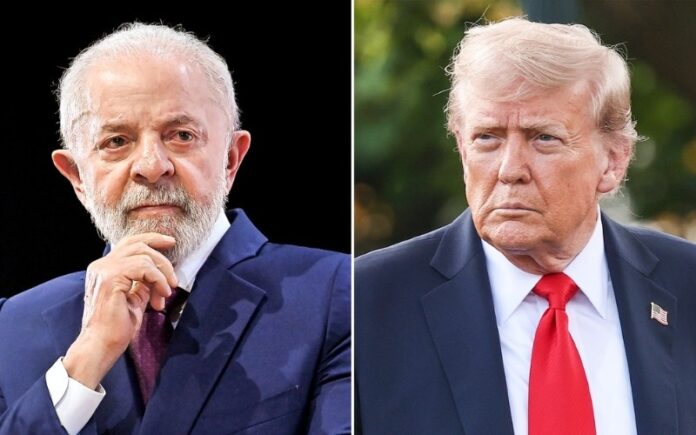
The United States aimed to make the moratorium permanent, but several developing countries, notably India, opposed it, fearing a loss of tax revenue. Brazil, for its part, did not want to extend it beyond two years.
Although a minimal compromise seemed possible on Sunday, Brazil blocked the moratorium text to protest U.S. demands and the lack of progress on agriculture. Brazilian Foreign Minister Mauro Vieira stated, “Agriculture is the sector that has seen the least progress in the WTO’s 30 years of existence. We cannot allow this to continue.”
A week before MC14, Brazil clearly indicated it was in favour of extending the moratorium until the next MC session, “while maintaining the long-standing practice of not extending it to digital content and allowing additional time to continue examining the economic and budgetary implications of the moratorium.”
On the Indian side, Abhijit Das, an international trade expert, head of the Centre for WTO Studies at the Indian Institute of Foreign Trade, and UNCTAD officer in India, explained to Digital Business Africa the reasons behind India’s opposition.
“India’s position is that we will oppose the moratorium because it hinders governments’ ability to generate revenue. REMEMBER, THESE ARE CUSTOMS DUTIES. INDIA BEARS THE NEGATIVE CONSEQUENCES, AS DO MANY OTHER DEVELOPING COUNTRIES. MAKING THIS MORATORIUM PERMANENT WOULD FORCE DEVELOPING COUNTRIES TO GIVE UP A CRUCIAL REVENUE SOURCE IN THE FUTURE”
An Atmosphere of Tensions and Disagreements
For nearly three decades, every WTO ministerial conference has renewed the moratorium. Its expiry in Yaoundé signifies a change. Even though Ngozi Okonjo-Iweala downplays this, noting that it had already been suspended in 1999 before being reinstated in 2001.
Beyond e-commerce, ministers failed to progress WTO reform. The organisation, weakened by political deadlock and the rise of protectionism, is struggling to reinvent itself.
At the press conference, Ngozi Okonjo-Iweala recognised the widespread disappointment: “We worked hard… We simply ran out of time.”
The head of the International Chamber of Commerce, John Denton, expressed his concern: “The failure of WTO members to reach a concrete political agreement in Yaoundé is particularly worrying at a time of real tension for the global economy.” For his part, UK Trade Secretary Peter Kyle called it a “major setback for global trade.”
Yaoundé: Theatre of a Global Deadlock
Yaoundé was intended to represent a fresh start for global trade cooperation. It will be remembered in history as the site of a significant deadlock: no agreement on the e-commerce moratorium, and no progress on agriculture and WTO reform.
For Africa, the event carries double symbolic importance: not only is the continent hosting a WTO ministerial conference for the second time, but it is also at the centre of global trade divisions, caught between the fiscal ambitions of developing countries and the defence of the digital interests of major powers.
After four days of intense debates, the 120 delegations from the WTO’s 166 members – including 80 ministers – leave Yaoundé with a sense of incompleteness, their focus now shifting to Geneva for further negotiations and to Washington, whose reaction will likely influence the future of e-commerce.
What remains now is to observe the follow-up negotiations in Geneva, as well as the United States’ and Donald Trump’s reactions, who view this failure as a strategic setback and a direct threat to American digital hegemony…
By Beaugas Orain DJOYUM
Box: Difference Between Electronic Transmissions and Digital Content
| Category | Definition | Concrete Examples | Coverage by the WTO Moratorium as of March 31, 2026 |
| Electronic Transmissions | Cross-border data flows that pass over the Internet or digital networks, without physical support. | – Downloading software from a foreign server – Streaming a movie or song – Transmitting an e-book – Software updates – Electronic documents sent by email |
✅ Yes — the moratorium prohibits imposing customs duties on these data flows |
| Digital Content | The digital good or service itself is once transmitted and consumed locally. | – The downloaded or streamed movie – Music purchased online – The installed software – The video game or mobile app – The e-book read on a tablet |
❌ No — the moratorium does not cover the content; states can apply VAT or local taxes |
Understanding the Moratorium:
The WTO moratorium protects only the transmission channel (cross-border data flows).
Countries retain the freedom to tax digital content (movies, software, music, etc.) through domestic taxes (VAT, digital services taxes).
Brazil, India, and some developing countries insist on this distinction to prevent the moratorium from becoming a permanent tax exemption benefiting major global digital platforms.
After March 31, 2026, in the absence of an agreement to extend the moratorium, WTO member countries can both impose customs duties on electronic transmissions and apply VAT or local taxes on digital content.
Also read: