


[DIGITAL Business Africa] – The British government’s decision on 4 March 2026 to impose a “visa brake” targeting, among others, Cameroon continues to raise questions. Official statistics from the UK Home Office indicate that the Central African country does not rank among the main nationalities applying for asylum in the United Kingdom. Yet London has decided to suspend sponsored student visas for Cameroonian nationals, citing a sharp rise in asylum claims from individuals who entered the country through certain legal migration routes.
Shortly after the announcement, the United Kingdom’s High Commissioner to Cameroon, Matt Woods, said in a statement that “from 26 March 2026, visa applications from Cameroonian nationals under the Student Visa category will be refused under the ‘Visa Brake’ mechanism introduced by the British government for certain visa routes.”
He later explained in a video message that more than 30% of Cameroonians who obtained a student visa over the past two years subsequently applied for asylum, thereby breaching the conditions of their visa.
UK Home Office data for 2025 shows most asylum applications are from Pakistan (10,638), Eritrea (8,948), Iran (7,419), and Afghanistan (6,462), with several other countries also exceeding 5,000 applications.
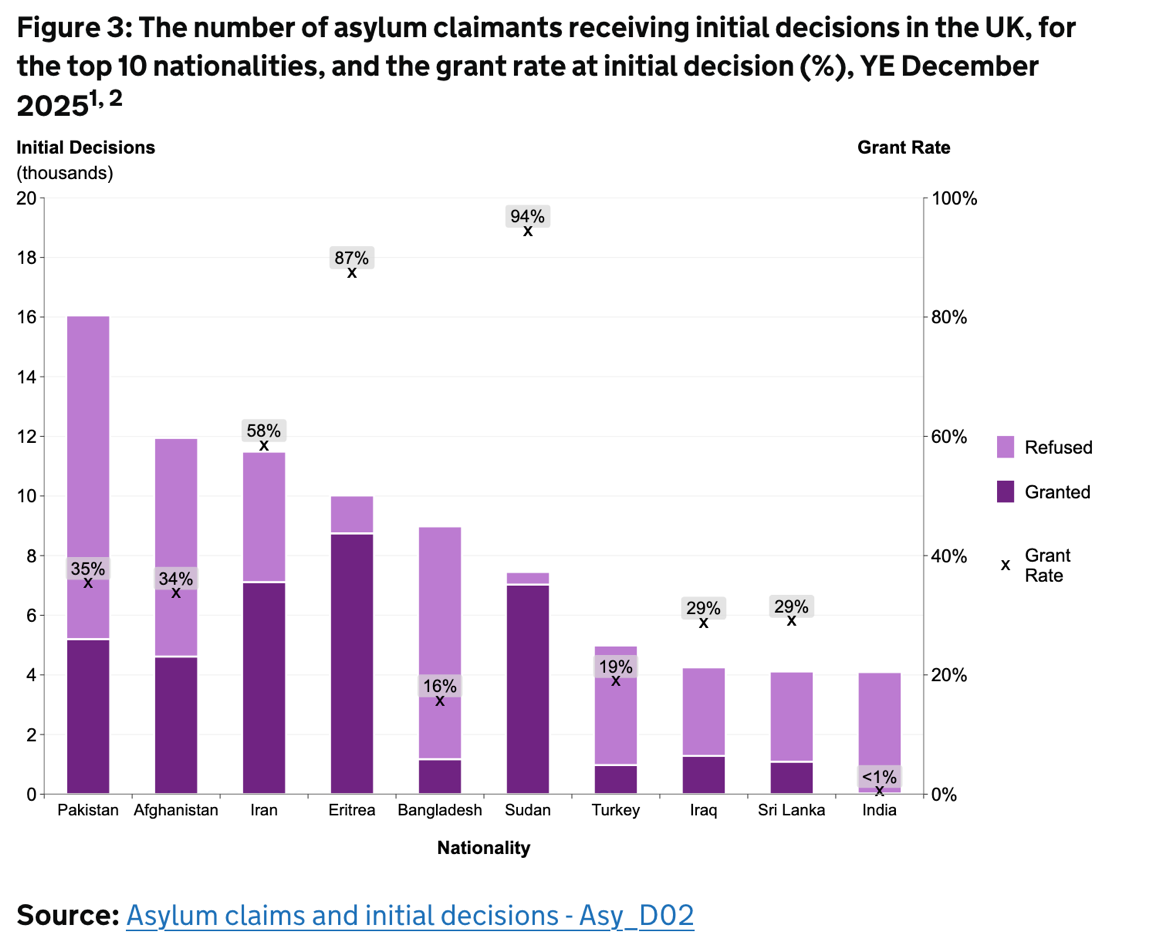
Conversely, Cameroon does not appear in the Top 20 nationalities with the most asylum applications. Cameroonian nationals are grouped in the “Other” category, which includes all nationalities, each of which represents a smaller volume of applications.
This statistical reality raises a central question: why is London targeting Cameroon when its overall weight in asylum applications remains relatively limited?
Top 20 Nationalities Applying for Asylum in the UK in 2025
| Rank | Nationality | Asylum Applications | Initial Decisions | Protections Granted | Refusals | Acceptance Rate |
| 1 | Pakistan | 10 638 | 16 054 | 5 201 | 10 853 | 35% |
| 2 | Eritrea | 8 948 | 10 017 | 8 748 | 1 269 | 87% |
| 3 | Iran | 7 419 | 11 487 | 7 113 | 4 374 | 58% |
| 4 | Afghanistan | 6 462 | 11 946 | 4 616 | 7 330 | 34% |
| 5 | Bangladesh | 6 247 | 8 981 | 1 174 | 7 807 | 16% |
| 6 | Sudan | 5 869 | 7 450 | 7 029 | 421 | 94% |
| 7 | India | 5 751 | 4 095 | 23 | 4 072 | 0% |
| 8 | Somalia | 4 777 | 3 330 | 1 237 | 2 093 | 35% |
| 9 | Nigeria | 2 904 | 3 623 | 856 | 2 767 | 28% |
| 10 | Vietnam | 2 428 | 3 515 | 659 | 2 856 | 19% |
| 11 | Brazil | 2 416 | 1 592 | 14 | 1 578 | 1% |
| 12 | Iraq | 2 370 | 4 252 | 1 284 | 2 968 | 29% |
| 13 | Sri Lanka | 2 243 | 4 114 | 1 090 | 3 024 | 29% |
| 14 | Ethiopia | 2 096 | 2 065 | 1 189 | 876 | 57% |
| 15 | Syria | 1 959 | 660 | 64 | 596 | 9% |
| 16 | Turkey | 1 883 | 4 988 | 977 | 4 011 | 19% |
| 17 | Albania | 1 816 | 1 874 | 121 | 1 753 | 5% |
| 18 | Yemen | 1 776 | 2 594 | 2 506 | 88 | 97% |
| 19 | Ukraine | 1 503 | 2 040 | 256 | 1 784 | 12% |
| 20 | China | 1 471 | 1 717 | 230 | 1 487 | 11% |
At the same time, student visas issued to Cameroonians remain relatively modest, hovering around a few hundred per year. Data from the UK Home Office indicates, for example:
| Year | Number of Applications |
| 2018 | 262 |
| 2019 | 262 |
| 2020 | 249 |
| 2021 | 437 |
| 2022 | 520 |
| 2023 | 489 |
| 2024 | 455 |
| 2025* | 507 |
A Decision Based on Ratios Rather Than Volume
The explanation provided by the Home Office is not based on the total volume of asylum applications, but on their recent trends and the entry routes used. The British government claims to have observed a sharp increase in asylum claims lodged by people who entered the UK legally, particularly with student visas.
Authorities indicate that student applications from nationals of four countries — Afghanistan, Cameroon, Myanmar, and Sudan — reportedly increased by more than 470% between 2021 and 2025.
According to Home Office statements, student applications from Cameroonian nationals rose by more than 330% over the same period. However, detailed data on the exact number of Cameroonian students who applied for asylum is not published on the UK Home Office website. Digital Business Africa will return to this question in a future article.
Nevertheless, a cross-analysis of Home Office data provides additional insight. Statistics show that the number of asylum applications lodged by Cameroonians already present in the UK — i.e., ‘In Country’ applications lodged by main applicants (students, tourists, workers, or other statuses) — rose from around 101 cases in 2021 to 544 in 2025.
When comparing these two statistical series, a particular phenomenon emerges. In 2024 and 2025, the number of asylum applications lodged by Cameroonians already present in the UK exceeded the number of student visas issued during those same years.
In 2024, for example, 478 ‘In Country’ asylum applications were recorded for 455 student visas issued. In 2025, statistics indicate 544 asylum applications for 507 student visas issued (data available up to September).
This unusually high ratio appears to be one of the main warning signals for the British authorities.
Comparative Table: Cameroon vs. Nigeria Asylum Applications by UK Residents (students, tourists, workers, or other statuses)
| Year | Cameroon | Nigeria |
| 2010 | 80 | 716 |
| 2011 | 76 | 657 |
| 2012 | 104 | 863 |
| 2013 | 111 | 882 |
| 2014 | 125 | 860 |
| 2015 | 129 | 880 |
| 2016 | 147 | 1130 |
| 2017 | 205 | 1013 |
| 2018 | 185 | 802 |
| 2019 | 214 | 818 |
| 2020 | 102 | 480 |
| 2021 | 101 | 490 |
| 2022 | 218 | 667 |
| 2023 | 167 | 704 |
| 2024 | 478 | 1721 |
| 2025 | 544 | 1846 |
Cameroon Ratio: Student Visas vs. Asylum Applications
| Year | Student Visas | Asylum Applications | Asylum / Visa Ratio |
| 2018 | 262 | 185 | 71 % |
| 2019 | 262 | 214 | 82 % |
| 2020 | 249 | 102 | 41 % |
| 2021 | 437 | 101 | 23 % |
| 2022 | 520 | 218 | 42 % |
| 2023 | 489 | 167 | 34 % |
| 2024 | 455 | 478 | 105 % |
| 2025 (jusqu’en septembre 2025) | 507 | 544 | 107 % |
NB: Asylum applications include all Cameroonians in the UK.
Until 2023, asylum applications remained lower than the number of student visas issued. A cross-analysis of Home Office statistics shows that in 2024 and 2025, the number of asylum applications lodged by Cameroonians already present in the UK exceeded the number of student visas issued during those same years. This unusually high ratio, even on a relatively limited overall volume, could explain the British authorities’ decision to restrict access to student visas for this nationality.
A Striking Contrast with Nigeria
Comparison with other African countries further illuminates the British government’s logic. Nigeria, for example, is one of the main nationalities of students in the UK.
Home Office data indicates that over 58,000 student visas were issued to Nigerians in 2022. Even after a recent decline, the country still accounts for more than 25,000 student visas in 2025 (data up to September).
At the same time, asylum applications lodged by Nigerians already present in the UK remain low. In 2025, there were 1,846 ‘In Country – Main Applicant’ asylum applications for over 25,000 student visas issued, a ratio of about 7%.
Nigeria Ratio: Student Visas vs. Asylum Applications
| Year | Student Visas | Asylum Applications | Asylum / Visa Ratio |
| 2018 | 5641 | 802 | 14 % |
| 2019 | 7027 | 818 | 12 % |
| 2020 | 9876 | 480 | 5 % |
| 2021 | 27011 | 490 | 2 % |
| 2022 | 58673 | 667 | 1 % |
| 2023 | 40869 | 704 | 2 % |
| 2024 | 21109 | 1721 | 8 % |
| 2025 (jusqu’en septembre 2025) | 25362 | 1846 | 7 % |
For Cameroon, however, this ratio exceeds 100% in some years, meaning that recorded asylum applications can be comparable to, or even greater than, the number of student visas issued.
Revealing Comparison of Cameroon vs. Nigeria Ratios
| Année | Ratio Cameroun | Ratio Nigeria |
| 2022 | 42 % | 1 % |
| 2023 | 34 % | 2 % |
| 2024 | 105 % | 8 % |
| 2025 | 107 % | 7 % |
In other words, even if the total number of Cameroonian students in the UK remains low, the proportion of asylum applications among people already present in the country appears significantly higher.
A Transformation of the British Asylum System
This situation is part of a broader transformation of the British asylum system. According to the Home Office, nearly 39% of asylum applications lodged in the UK in 2025 now come from people who entered the territory legally, particularly with student or work visas.
Ministry statistics indicate that in the year ending December 2025, 39,095 asylum applicants held a visa or another form of leave before applying.
Among them:
- 35% held a work visa
- 32% held a student visa
- 19% held a visitor visa
- 14% held other forms of leave
These figures illustrate a major shift: a growing share of asylum applications now comes from people who entered the UK legally.
Why This Topic Also Concerns the African Digital Ecosystem
Beyond migration issues, this matter also concerns the African tech ecosystem. A significant portion of African students going to the UK choose courses in technology-related fields, including computer science, data science, engineering, cybersecurity, and artificial intelligence.
According to statistics from the UK’s Higher Education Statistics Agency (HESA), international students in the UK are mainly concentrated in fields such as Business and Management, Computing/IT, Engineering, and Social Sciences, which are among the most popular courses in British universities.
For many Cameroonian students, British universities thus represent a pathway to acquiring advanced technological skills that are subsequently valued in the digital, telecommunications, fintech, and innovation sectors.
The British decision to suspend certain student visas could therefore have implications beyond migration issues, also impacting the educational paths of many young Africans in key fields such as technology and digital skills.
This is also why Digital Business Africa, a media outlet specialised in ICT, telecommunications, and innovation news in Africa, is interested in this decision and its possible effects on the development of training and the exchange of digital skills between Africa and major international tech hubs.
A Measure That Raises Questions About the Coherence of Immigration Policy
Despite London’s explanations, the decision still raises questions. While Cameroon has a high ratio of student visas to asylum applications, the overall number remains much lower than that of several other nationalities in the British asylum system.
The question posed thus extends beyond the Cameroonian case alone. Why opt to suspend access to student visas for an entire nationality instead of directly addressing the individual cases where student visa holders seek asylum after arriving in the UK? And why is such a measure implemented while other countries, like Nigeria, continue to send tens of thousands of students to British universities each year?
Beyond the migration debate, this decision reveals a deeper shift: the global politics of education and talent. For twenty years, major Anglo-Saxon universities have become key training hubs for the scientific, technological, and entrepreneurial elites of the Global South.
In this context, student visa policies are no longer solely concerned with the administrative management of migration. They also function as instruments of economic, scientific, and geopolitical policy.
The British decision, therefore, prompts a wider question for Africa: in a world where major powers are gradually tightening their immigration policies, how will countries on the continent continue to train, attract, and retain the technological skills on which their digital transformation depends?
For British universities, African students, and the continent’s emerging digital ecosystems, the evolution of these policies could well herald a new phase in the global competition for talent.
By Beaugas Orain DJOYUM
Also read: …https://www.digitalbusiness.africa/en/united-kingdom-london-suspends-student-visas-for-cameroonians-following-a-surge-in-asylum-applications/