


[DIGITAL Business Africa] – Artificial intelligence (AI)-related goods have emerged as the main driver of global trade growth in 2025, confirming that the digital economy now rests on massive flows of high-value physical goods. This is one of the key findings of the updated 7 October 2025 edition of the World Trade Outlook and Statistics published by the World Trade Organisation (WTO).
According to WTO economists, trade in AI-related goods – covering around 100 product lines, ranging from semiconductors and processors to finished computers, servers, and telecommunications equipment – expanded by more than 20% year on year in the first half of 2025. In value terms, these exchanges reached USD 1.92 trillion, compared with USD 1.61 trillion over the same period in 2024.
By comparison, trade in non-AI goods grew by less than 4% over the same period. Although AI-related products account for less than one-sixth of global merchandise trade, they contributed nearly half of overall trade growth in the first half of 2025, accounting for 43% of that growth.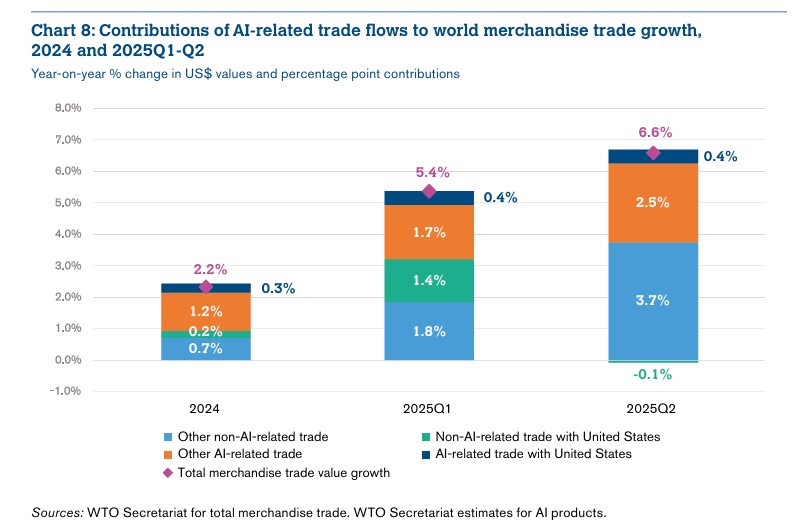
This chart shows that global trade growth in 2025 is largely driven by AI-related goods. While non-AI trade is expanding only modestly, flows of semiconductors, servers, and telecommunications equipment account for most of the increase in the value of world trade, confirming the structuring role of AI in the international economy.
A profound restructuring of global trade around AI
For the WTO, these figures reflect a deep restructuring of global economies around artificial intelligence. The observed momentum spans the entire digital value chain: from raw silicon and speciality gases to the machines used in semiconductor manufacturing and testing, and on to the servers and computers powering cloud computing platforms and AI applications worldwide.
The United States played a leading role in merchandise trade developments in the first half of 2025. Imports rose sharply in the first quarter as firms front-loaded purchases ahead of anticipated tariff increases. However, this cyclical effect faded in the second quarter as inventories built up earlier in the year were drawn down.
AI-related goods, by contrast, followed a more stable trajectory. Unlike the volatility observed for other products such as precious metals or pharmaceuticals, US imports of semiconductors, servers and finished computers continued to grow at a steady pace. This stability suggests that demand for AI infrastructure is primarily driven by long-term structural investment rather than short-term trade policy arbitrage.
A dynamic increasingly driven by emerging economies
By the second quarter of 2025, momentum in AI-related trade had gradually shifted beyond the United States. Other economies accounted for nearly 40% of global AI-related trade growth, with a marked rise in Asian suppliers and emerging markets.
Asia accounted for nearly two-thirds of global growth in AI-related trade in the first half of 2025. East Asia – notably the Republic of Korea, Japan and Chinese Taipei – remained the engine of supply of semiconductors and advanced telecommunications equipment. At the same time, South-East Asian economies such as Viet Nam and Thailand strengthened their roles, supported by supply-chain diversification and increased investment.
Other regions are also asserting themselves in this dynamic. The Middle East increased its imports of servers and telecommunications hardware, linked to government-led digital transformation programmes in Saudi Arabia and the United Arab Emirates. In South America, Brazil and Chile stepped up purchases of computing and cloud-related equipment.
In Africa, growth remains uneven but tangible: South Africa, Nigeria and Egypt increased their imports of telecommunications infrastructure, signalling investment in connectivity as a prerequisite for broader digital adoption.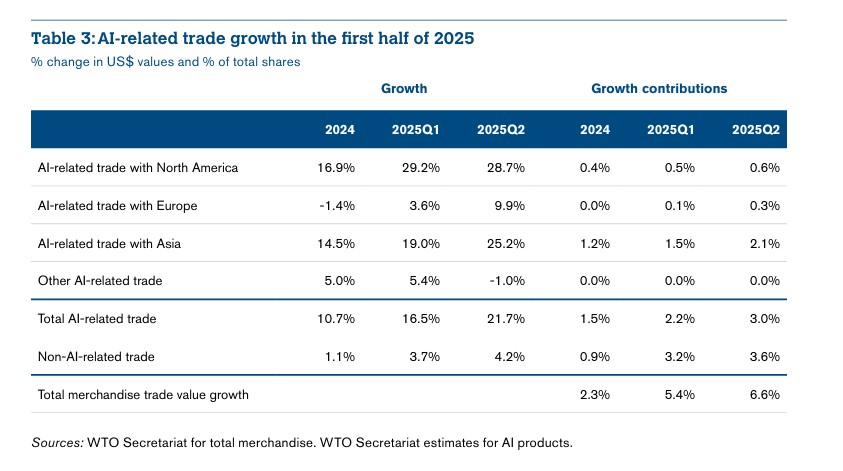
WTO warnings for 2026
In their analysis, WTO economists nevertheless stress that global trade growth is likely to slow in 2026, due to the combined effects of a decelerating global economy and the introduction of new tariffs. The robustness observed in 2025 may therefore not be sustained at the same pace.
WTO Director-General Ngozi Okonjo-Iweala welcomed the resilience of global trade in 2025, while calling for vigilance. According to her:
“The measured response of countries to tariff changes in general, the growth potential of AI, and increased trade in the rest of the world – particularly among emerging economies – helped mitigate trade setbacks in 2025.”
She also highlighted the rise in trade among countries of the Global South. According to the WTO, South-South trade increased by 8% in value in the first half of 2025, compared with 6% for global trade overall. South-South trade with partners other than China grew even faster, rising by close to 9%.
The key role of trade multilateralism
For Ngozi Okonjo-Iweala, this resilience is not accidental. It largely reflects the stability provided by the rules-based multilateral trading system.
“The resilience of trade in 2025 owes no small part to the stability provided by the rules-based multilateral trading system. However, complacency is not an option. The current disruptions to the global trading system call on nations to act to reinvent trade and jointly establish a stronger foundation that delivers greater prosperity for people around the world,” she added.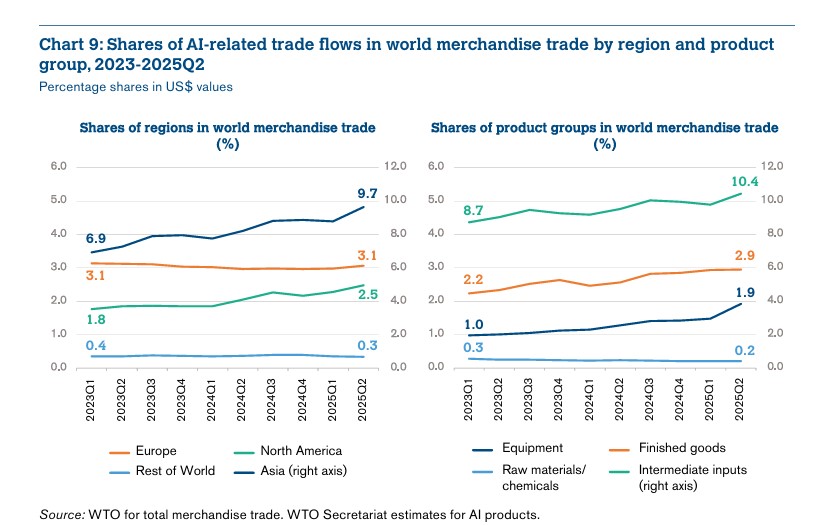
A central challenge for developing countries
These developments confirm that tomorrow’s global trade will increasingly be structured around artificial intelligence and digital infrastructure. For developing countries, and Africa in particular, the challenge goes beyond simply consuming technology: it is about integrating into AI value chains, capturing a share of industrial value added, and anticipating the fiscal, customs and regulatory implications of this transformation.
For African policymakers, these data also point to the urgent need to rethink industrial, customs, and tax policies so that Africa does not remain merely an import market for AI infrastructure but becomes an actor in its production, assembly, and regulation.
This reading is shared in full by the WTO Secretariat. Commenting on the study’s findings, WTO Director-General Ngozi Okonjo-Iweala stressed that the new trade data confirm a structural shift in global trade driven by artificial intelligence and the digital economy.
“For the sake of growth, development and employment prospects across the WTO membership, we must sustain what is working well. But we must also reform what is not working and reposition our Organisation to better support Members in taking advantage of exciting new trade opportunities – particularly in the digital economy. The latest trade data are among the latest signs that artificial intelligence is no longer an emerging issue on the horizon: it has arrived, with very significant implications for trade, as underscored in our recently released World Trade Report entitled ‘Making Trade and Artificial Intelligence Work Together for the Benefit of All’.”
In this statement, the WTO Director-General clearly calls on Members to move beyond a passive or defensive approach to the digital transformation of global trade.
For her, artificial intelligence is no longer a prospective or theoretical issue but a fully-fledged economic reality that is already shaping trade, requiring both the consolidation of the effective elements of the multilateral trading system and reforms to better support the new opportunities offered by digital trade.
As the WTO debates the future of the moratorium on electronic transmissions and the multilateral framework for digital trade, the 2025 figures highlight an essential reality: the digital economy is increasingly material, industrial and strategic. Ignoring this dimension would mean missing one of the major industrial, technological and strategic turning points in contemporary global trade.
By Beaugas-Orain DJOYUM