
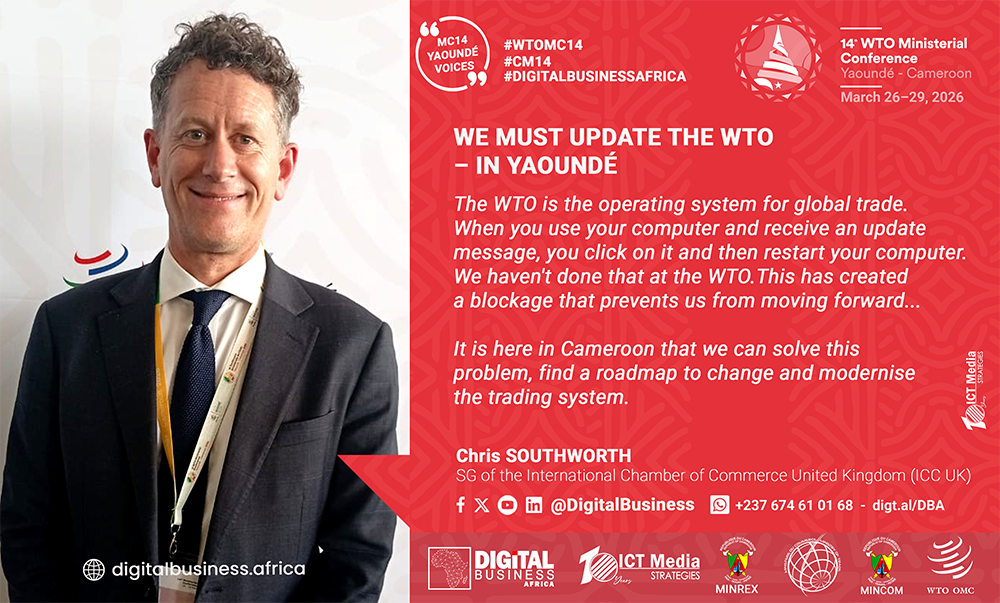

[Digital Business Africa] – Chris Southworth is the Secretary General of the International Chamber of Commerce United Kingdom (ICC UK). He is a recognised expert in trade policy and digital trade. He is co-founder of the UK Centre for Digital Trade and Innovation, ICC’s representative to the Commonwealth, and a member of the ICC Global Council. He is in Yaoundé for the WTO MC14.
In this interview with Digital Business Africa, he highlights the various issues hindering the global and African economies and the actions the WTO and individual countries must take to catch up.
Digital Business Africa: Does the 14th Ministerial Conference (MC14) represent a turning point for the future of the World Trade Organisation (WTO)?
Chris Southworth: Yes. It is a moment of growth for the World Trade Organisation and the multilateral trading system. The truth is that trade has lifted one billion people out of poverty. We live in the 21st century with modern technology. The WTO rules do not reflect the world we live in, nor consumers, nor trade, but especially trade. The global economic order is evolving, which creates geopolitical tensions. But there are also demographic changes, particularly in Africa. The production and consumption base has changed dramatically over this time.
This is a very important moment for all governments, which must unite around the idea of updating the system. The best way to understand it is to compare it to a computer. The WTO is the operating system for global trade. When you use your computer and receive an update message, you click on it and then restart your computer. We haven’t done that at the WTO.
This has created a blockage that prevents us from moving forward. We are not solving the problems of the past. It is here in Cameroon that we can solve this problem, find a roadmap to change and modernise the trading system.
Digital Business Africa: What are the other issues that, in your view, undermine the functioning of the WTO?
Chris Southworth: Despite lifting one billion people out of poverty, mainly in the Global South, which is great, there has been a huge political backlash in the Global North, because living standards have declined significantly over the past 10 to 15 years.
That is why you now see major political trends. Look at America, and, in particular, at Europe: there is very little political support for multilateralism. People want to act unilaterally to protect their own voter bases, consumers, and economies. We need growth. We need to be competitive. We need to raise living standards. The World Trade Organisation sets standards.
In one part of the world, that has been beneficial. In the other, it has not. Now, it is about creating a higher playing field. That is one of the issues. Another observation: economies that were small are now larger than they were back then.
Look at India: it is larger than France. China is now number two. It was not number two 20 years ago. The system does not reflect these changes. Many countries are now developed.
This creates a lot of friction in the system regarding how to ensure that development happens fairly for everyone. The third issue relates to the changing global economic order. The most powerful players in the world are now completely different.
There is a significant power shift from the United Kingdom towards the West and large blocs of countries. Africa is one of these. Africa’s influence is much greater than it was 20 years ago. The same is true in Asia. Therefore, the players in the global system are very different from those of the past.
It is no longer just the G7. It is much more complex. This creates a lot of friction as this change unfolds. It is not that change is bad, but it is change, and the WTO system does not reflect it.
Digital Business Africa: What role does digital play within the WTO system?
Chris Southworth: Digital influence is vital. This is not a technical project. The trading system has remained largely unchanged for 200 years. The documents that businesses complete when crossing borders or exchanging finances are the same as those from two centuries ago. It is all paper-based. There are 4 billion pieces of paper circulating within the system. It is highly bureaucratic. It is slow, inefficient, and costly.
And of course, we are using all modern technologies. The system itself is simply not suitable for the needs of modern business. That is the critical issue with digital. It means we need to make a major transition from paper to the digital economy, where we know that businesses do not transition in 2 to 3 months, but in 1 hour, 1 minute. That is a drastic shift towards a simpler, faster way.
We know that the benefits for everyone, especially small businesses, are immense in terms of efficiency, growth, and access to finance. These are key issues we aim to solve. And naturally, the most straightforward solution is to digitalise the trading system.
But we need to move much faster than we are at present. Currently, it is too slow and does not meet business needs. We all want to be competitive. We must be agile in today’s world, where we face tariffs, export controls, and sanctions. The system is very complex.
Digital Business Africa: What is your view on the digitalisation of businesses worldwide?
Chris Southworth: Digitalisation enables businesses to move faster through transit, access more working capital, and be more liquid than they appear on paper, where all the money remains tied up in the export chain. Digitalisation is a key solution. That’s why it’s so important. But we must ensure it benefits everyone. It cannot be limited to major economies alone. We must do it with everyone.
It is in our interest to be collaborative, but we must improve the rules. We need to establish the digital infrastructure required everywhere, not just in certain regions of the world. Otherwise, people will be left behind, which is the very opposite of what we all aim to achieve.
We aim to elevate living standards, boost economies, and become more resilient in a modern environment. And digitalisation is entirely the solution.
Digital Business Africa: What are the risks for global growth in the event of a slowdown in progress?
Chris Southworth: This is a good moment to think about that. For example, Europe is highly unstable politically. From a business point of view, stability and predictability are crucial. Without stability, investment will not happen, resulting in no jobs, no growth, and no prosperity.
The more unstable the political climate, the harder it is for businesses to expand. However, if growth stalls, the pressure on governments to foster economic development becomes intense. This leads to more frequent changes in housing, public services, and jobs—not only in some regions but across all areas.
It is more politically complicated. This makes it harder for businesses to invest. Ultimately, it leads to inflation, rising costs, increased complexity, and also impacts consumers. When consumers face higher costs, businesses encounter more complexity and expenses. We all suffer, and that is not in our best interest.
We need to collaborate with politicians to enhance political stability. Growth is essential to compete and develop simultaneously while staying stable and prosperous.
Interview conducted by Ghislaine DEUDJUI
Also read: